
Why One-Piece Collars Are Difficult to Manufacture
A one-piece collar looks simple.
In reality, it is one of the shirt constructions where simplicity of appearance can require significantly more precision behind the scenes.
Unlike a conventional shirt collar, where the collar and collar stand are separate components, a one-piece collar is designed to create the collar and its transition into the neckline through a more integrated construction.
The result can be elegant, relaxed, and distinctive.
But achieving the right result consistently is not simply a matter of removing the collar stand.
The pattern, fabric, structure, collar roll, neckline balance, sewing technique, and pressing all have to work together.
For fashion brands looking for a one-piece collar shirt manufacturer, this is an important distinction.
A factory may be experienced in producing conventional shirts and still require specific technical knowledge to manufacture a well-balanced one-piece collar.
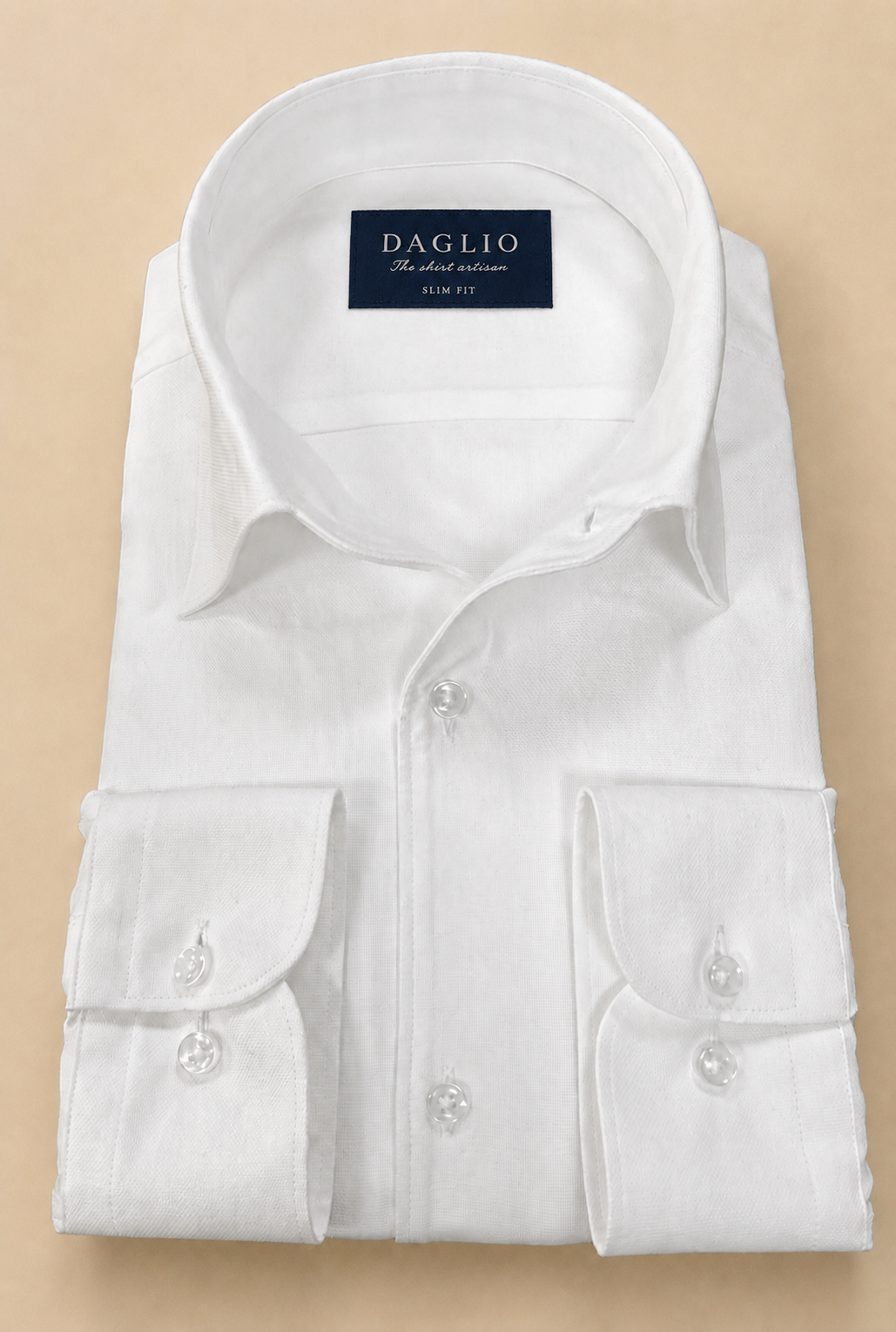
A One-Piece Collar Is a Pattern Engineering Challenge
The first challenge begins before the fabric reaches the cutting table.
A conventional shirt collar typically separates different functions between the collar and collar stand.
With a one-piece construction, these relationships have to be reconsidered within the pattern itself.
Small changes can influence:
Collar height
Collar spread
Neckline fit
Collar opening
Front balance
Collar roll
How the collar sits under a jacket
How it behaves when the top buttons are open
This makes pattern development particularly important.
A few millimeters in the wrong place can change the entire character of the finished shirt.
That is why copying the shape of an existing collar is not enough.
The pattern has to be engineered for the intended fabric, fit, construction, and visual result.
The Collar Roll Is One of the Hardest Details to Get Right
One of the defining characteristics of a good one-piece collar is its roll.
The collar should not simply stand upright.
It should transition naturally from the neckline and create the intended shape around the neck and chest.
Too much structure can make it look stiff.
Too little structure can cause it to collapse.
The wrong pattern can make the two sides behave differently.
And an unsuitable fabric can completely change the intended silhouette.
This balance between structure and softness is one reason one-piece collar manufacturing requires more than standard sewing capability.
The factory needs to understand what the designer is trying to achieve.
Is the collar supposed to look formal?
Relaxed?
Architectural?
Soft and Italian-inspired?
Designed primarily to be worn open?
The answer changes the technical approach.
Fabric Changes Everything
The same one-piece collar pattern cannot necessarily be transferred from one fabric to another without adjustment.
A crisp cotton poplin behaves differently from linen.
Oxford has a different body.
A lightweight cotton may need additional support.
A stretch fabric introduces another set of considerations.
Jersey can require an entirely different approach to stabilization and construction.
This is where experienced shirt manufacturing becomes important.
The question is not simply:
“Can this fabric be sewn?”
The better question is:
“Can this fabric produce the collar shape the brand wants?”
Those are two very different questions.
A fabric may be technically possible to manufacture but unsuitable for the desired collar architecture.
An experienced manufacturer should be able to recognize that distinction before bulk production.
Interlining Must Support the Collar, Not Control It
Interlining plays an important role in many shirt collars.
But with a one-piece collar, simply choosing a harder interlining does not automatically create a better result.
In fact, excessive rigidity can destroy the natural roll that makes this collar attractive in the first place.
The relationship between:
fabric,
interlining,
pattern,
fusing,
and pressing
has to be considered as a system.
The goal is not maximum stiffness.
The goal is controlled structure.
The collar needs enough support to retain its intended shape while still behaving naturally when worn.
That balance can require development and testing rather than relying on a standard collar specification.
Left-to-Right Symmetry Becomes Highly Visible
A one-piece collar naturally attracts attention to the upper part of the shirt.
That means asymmetry becomes easier to notice.
If one side rolls differently from the other, the customer sees it.
If the collar points sit at slightly different angles, the customer sees it.
If the neckline pulls differently on one side, the entire front of the shirt can appear unbalanced.
This is why precision during cutting, sewing, fusing, and pressing matters.
Premium shirt manufacturing is often defined by differences measured in millimeters rather than centimeters.
The Front of the Shirt and the Collar Must Work Together
One-piece collars cannot be treated as isolated components.
The front body, neckline, placket, shoulder and collar influence one another.
This becomes especially important when the shirt is designed to be worn with one or two buttons open.
The designer may want the collar to create a particular opening around the chest.
If the geometry is wrong, several problems can appear:
The collar may spread too far.
The front may pull.
The neckline may open excessively.
The collar may collapse backward.
One side may sit differently from the other.
A successful one-piece collar therefore depends on garment balance, not just collar construction.
Pressing Is Part of the Engineering
Pressing is sometimes viewed as a finishing operation.
For complex shirt constructions, it can be much more than that.
The way a one-piece collar is shaped during production affects its final appearance.
Incorrect pressing can flatten the natural roll.
Excessive pressure can create unwanted sharpness.
Poor handling can distort the shape established by the pattern.
Experienced shirt makers understand that pressing should reinforce the intended construction rather than fight against it.
The finished collar should look natural because the pattern, construction and finishing are working together.
Making One Good Sample Is Not the Hardest Part
This is an important point for fashion brands.
Producing one attractive development sample does not necessarily prove that a factory has mastered the construction.
The greater challenge is repeatability.
Can the manufacturer reproduce the same:
Collar height
Opening
Roll
Symmetry
Shape
Fit
Overall appearance
across 100, 500 or several thousand shirts?
That is where industrial shirt manufacturing differs from sample making.
A beautiful sample demonstrates possibility.
Consistent bulk production demonstrates manufacturing capability.
One-Piece Collar Manufacturing Requires Shirt Specialization
This is also why brands should distinguish between a general garment manufacturer and a specialized men's shirt manufacturer.
A shirt contains its own technical language.
Collar geometry.
Neckline balance.
Sleeve positioning.
Cuff construction.
Placket behavior.
Interlining.
Pattern grading.
Pressing.
Fabric-specific adjustments.
When a factory works with shirts continuously, these details become part of its technical expertise.
This is particularly valuable for non-standard constructions such as the one-piece collar.
One Design Can Require Several Prototypes
Brands sometimes expect the first sample to represent the final answer.
For specialized collars, development can be more iterative.
The first prototype may answer one question:
Is the overall geometry correct?
The next may refine the roll.
Another adjustment may be required after changing the fabric.
A further modification may improve how the collar behaves when worn open.
This should not automatically be seen as a manufacturing weakness.
When developing a distinctive product, controlled iteration can be part of responsible product development.
The important factor is whether each revision has a technical purpose.
The Best One-Piece Collar Is Not Necessarily the Most Dramatic
A common mistake is assuming that a distinctive collar has to be exaggerated.
Not necessarily.
A successful one-piece collar should fit the identity of the brand.
For one collection, that might mean a strong architectural roll.
For another, the best solution could be much more subtle.
Premium manufacturing is not about making every technical feature visible.
It is about controlling the feature well enough that it looks intentional.
That distinction is important.
The manufacturer should not impose its preferred collar on every customer.
It should be capable of developing the collar the brand wants.
What Should Brands Ask a One-Piece Collar Shirt Manufacturer?
If you are sourcing a factory specifically for this type of product, don't simply ask:
“Can you make a one-piece collar?”
Almost any factory can answer yes.
More useful questions include:
Have you developed one-piece collar patterns before?
Can you adjust the collar for different fabrics?
How do you control collar roll?
How do you determine the appropriate structure or interlining?
Can you develop different one-piece collar shapes?
How do you maintain symmetry in bulk production?
Can the collar be optimized for open-neck wear?
How do you ensure the approved sample can be repeated in production?
The answers reveal much more about the manufacturer's actual shirt-making expertise.
Why Mehmet Dağ Shirts Specializes in One-Piece Collar Shirts
At Mehmet Dağ Shirts, one-piece collar shirts are not treated as an unusual request outside our normal production capability.
They are part of our broader specialization in men's shirt manufacturing.
For more than 25 years, we have focused on shirts.
That specialization has allowed us to build practical experience across different collar constructions, fabrics, fits and product categories.
Our approach to one-piece collar development considers the complete garment rather than treating the collar as an isolated component.
We evaluate the relationship between:
Pattern geometry
Neckline
Fabric
Desired collar roll
Structure
Front opening
Fit
Construction
Pressing
Bulk repeatability
This allows us to work with brands looking not merely for a factory capable of sewing a one-piece collar, but for a one-piece collar shirt manufacturer capable of developing and industrializing the product.
More Than One Type of Shirt
Our specialization in men's shirts also allows us to work across different product directions.
Depending on the project, our production capabilities include:
Business shirts
Casual shirts
Linen shirts
Jersey and knitted shirts
Overshirts
Non-iron shirts
Tuxedo shirts
One-piece collar shirts
Custom private label shirt collections
This range matters because specialized collar development cannot be separated from fabric and product knowledge.
A one-piece collar intended for a lightweight summer shirt should not necessarily be approached in the same way as one developed for a more structured premium shirt.
A Shirt Manufacturer Should Help Turn Design Into a Repeatable Product
There is a major difference between creating an interesting sample and creating a commercially viable product.
Fashion brands need both.
The first requires development.
The second requires manufacturing discipline.
Our role as a private label shirt manufacturer in Turkey is therefore not simply to reproduce a drawing.
We aim to understand the desired product, identify technical challenges, develop an appropriate construction and then translate the approved result into repeatable production.
That is particularly important for distinctive shirt details such as one-piece collars.
Because a signature detail only creates value for a brand if it can be produced consistently.
Why Specialization Matters When Choosing a Shirt Manufacturer
If your collection is built around shirts, choosing a manufacturer based solely on general apparel experience may not be enough.
Ask what the factory specializes in.
Ask which constructions it develops regularly.
Ask whether it understands different collar architectures.
Ask how it moves from prototype to bulk production.
Ask whether technical knowledge stays inside the company from one collection to the next.
The more important shirts are to your brand, the more important shirt-specific manufacturing knowledge becomes.
At Mehmet Dağ Shirts, this specialization has been developed over more than two decades of focusing on men's shirts.
Our objective is not to manufacture every category of apparel.
Our objective is to understand shirts exceptionally well.
Final Thoughts
One-piece collars demonstrate an important principle about premium shirt manufacturing:
The simplest-looking details are often the most technically demanding.
A successful one-piece collar requires more than removing a traditional collar stand.
Pattern geometry, fabric behavior, interlining, collar roll, garment balance, sewing precision, pressing and production consistency all influence the final result.
For brands, this makes the choice of manufacturer particularly important.
You don't only need a factory that can sew the design once.
You need a manufacturer that understands why the design works—and can reproduce that result consistently when the collection goes into production.
That is the difference between making a sample and mastering a product.
And it is exactly where specialized shirt manufacturing proves its value.
