
Dress Shirt Manufacturer for U.S. Brands: What American Menswear Companies Should Look For
Finding a dress shirt manufacturer for a U.S. brand is not simply a matter of finding a factory that can sew a shirt.
A dress shirt is a structured product. Its quality depends on the relationship between fabric, pattern, fit, collar construction, interlining, stitching, cuffs, plackets, pressing, measurements and finishing. More importantly, a manufacturer must be able to reproduce that standard consistently from the approved sample to bulk production.
For American menswear brands, this creates an important distinction:
A factory that can manufacture shirts is not necessarily a specialized dress shirt manufacturer.
The right manufacturing partner should understand not only how to produce the garment, but also how the shirt is expected to fit, perform, look and represent the brand when it reaches the U.S. customer.
M.DAG Shirts is a specialized men's shirt manufacturer based in Istanbul, producing private label shirts with more than 25 years of shirtmaking experience.
Our focus is straightforward:
Premium quality. Consistent production. Reliable communication. Commercially realistic pricing. And flexibility where it genuinely helps the brand.
This guide explains what U.S. brands should look for when choosing a dress shirt manufacturing partner — and why the difference between an ordinary garment factory and an experienced shirt manufacturer becomes visible in the final product.
What Is a Dress Shirt Manufacturer?
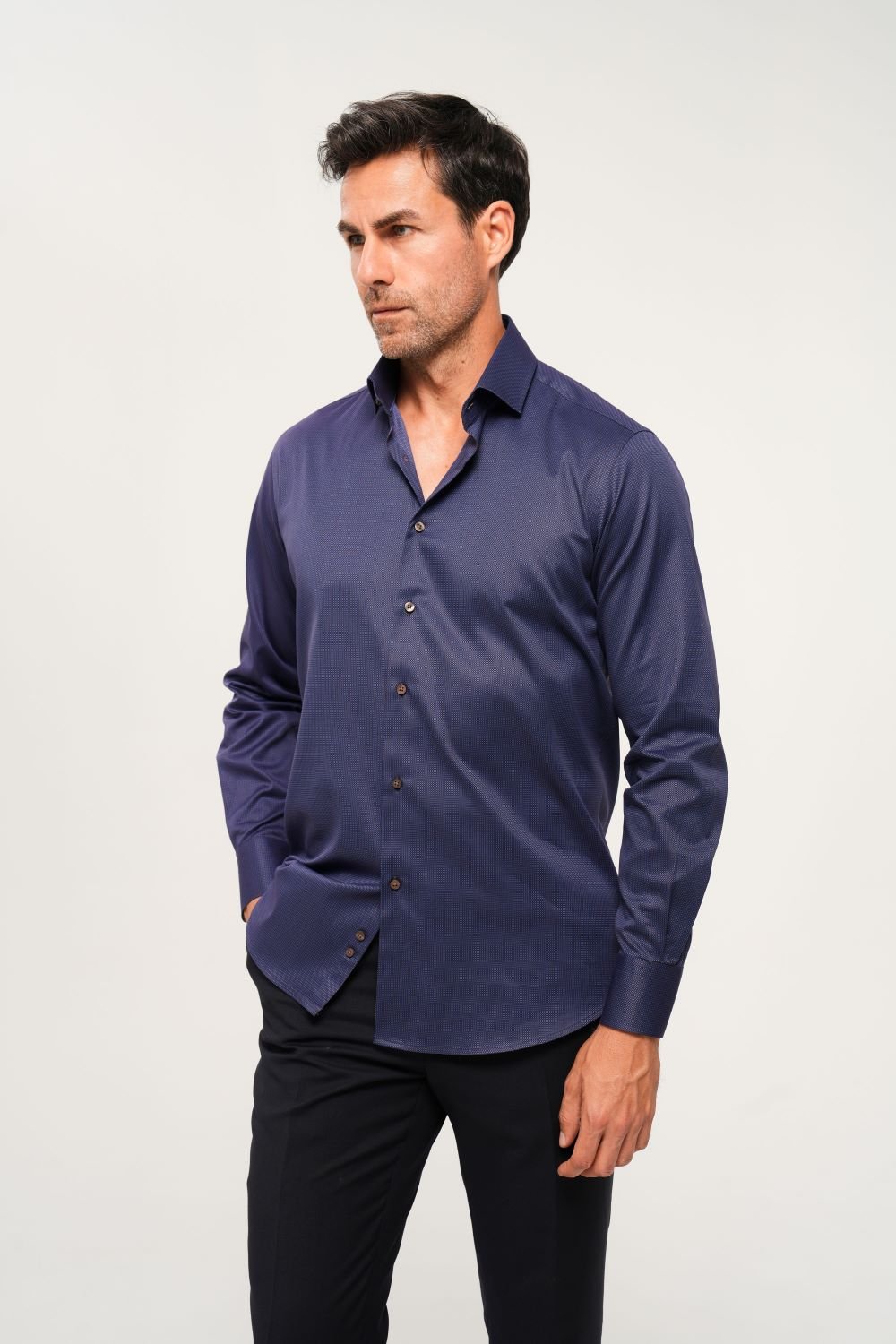
A dress shirt manufacturer is a garment producer specializing in the development and production of structured woven shirts, including classic business shirts, formal shirts, premium cotton shirts and other tailored men's shirt categories.
A specialized manufacturer should be capable of managing more than sewing.
The complete process may involve:
fabric sourcing and development,
pattern development,
fit adjustments,
size grading,
collar construction,
interlining selection,
cuff development,
placket construction,
cutting,
sewing,
button and buttonhole operations,
pressing,
measurement control,
quality inspection,
labeling,
packaging,
and preparation for international shipment.
For a private label brand, the factory must also translate the brand's specifications into a repeatable production standard.
That distinction matters.
A private label dress shirt manufacturer does not simply manufacture its own shirt with another company's label. It should manufacture the brand's shirt.
What Should U.S. Brands Look for in a Dress Shirt Manufacturer?
American menswear companies should evaluate a potential shirt manufacturer across several dimensions:
shirt specialization, product development capability, fabric knowledge, pattern and fit expertise, workmanship, quality control, sample-to-bulk consistency, customization, communication, production flexibility and commercial reliability.
Price matters.
MOQ matters.
Lead time matters.
But none of these should be evaluated in isolation.
The real question is:
Can this manufacturer repeatedly produce the shirt standard your brand intends to sell?
That is the foundation of a successful manufacturing relationship.
1. Choose a Shirt Specialist, Not Simply a Garment Factory
A factory may be excellent at producing T-shirts, sweatshirts, trousers or jackets.
That does not automatically make it an excellent dress shirt manufacturer.
Shirts have their own manufacturing logic.
Consider the relationship between:
collar and collar stand,
fabric and interlining,
neck measurement and body fit,
shoulder and armhole,
sleeve angle and movement,
cuff and sleeve opening,
front placket and button positioning,
pattern and fabric shrinkage,
pressing and final appearance.
These elements interact with one another.
Changing one can influence another.
This is why specialization matters.
At M.DAG Shirts, our manufacturing knowledge has been built around shirts for more than 25 years.
For a brand looking for a premium men's shirt manufacturer, specialization should be one of the first questions — not one of the last.
2. A Premium Dress Shirt Starts With the Right Fabric — Not Simply an Expensive Fabric
One of the most common misconceptions in premium menswear is that an expensive fabric automatically creates an expensive-looking shirt.
It does not.
A fabric has to work with the intended product.
A crisp business poplin behaves differently from Oxford.
Linen behaves differently from stretch cotton.
A lightweight formal fabric behaves differently from flannel.
Technical stretch fabrics introduce another set of production considerations.
The manufacturer needs to understand how fabric characteristics influence:
cutting,
shrinkage,
sewing,
seam appearance,
collar behavior,
fusing,
pressing,
drape,
fit,
and final garment appearance.
For U.S. brands, fabric selection should therefore begin with the target product and customer rather than a swatch book alone.
A good manufacturer asks:
What is the shirt designed for?
Business?
Formalwear?
Travel?
Hospitality?
Premium casual?
Summer?
Performance?
Retail basics?
The correct fabric is the fabric that supports the intended shirt.
3. Fit Should Be Developed for the Brand — Not the Factory
This is especially important in private label manufacturing.
Factories often have existing patterns.
That can be useful as a starting point.
But a U.S. menswear brand should not be forced into the manufacturer's generic fit if its customer requires something different.
A private label manufacturer should be able to work from:
a tech pack,
an existing size chart,
a reference garment,
an established brand block,
or a newly developed pattern.
Fit must also be considered as a complete system.
A shirt can technically pass individual measurements and still feel wrong when worn.
Shoulder balance, chest ease, armhole position, sleeve movement, collar comfort and front-to-back balance all contribute to how the shirt performs on the body.
Measurement compliance and good fit are related, but they are not identical.
For brands building a long-term dress shirt program, the goal should be to establish a fit that can become part of the brand's identity and then reproduce it consistently.
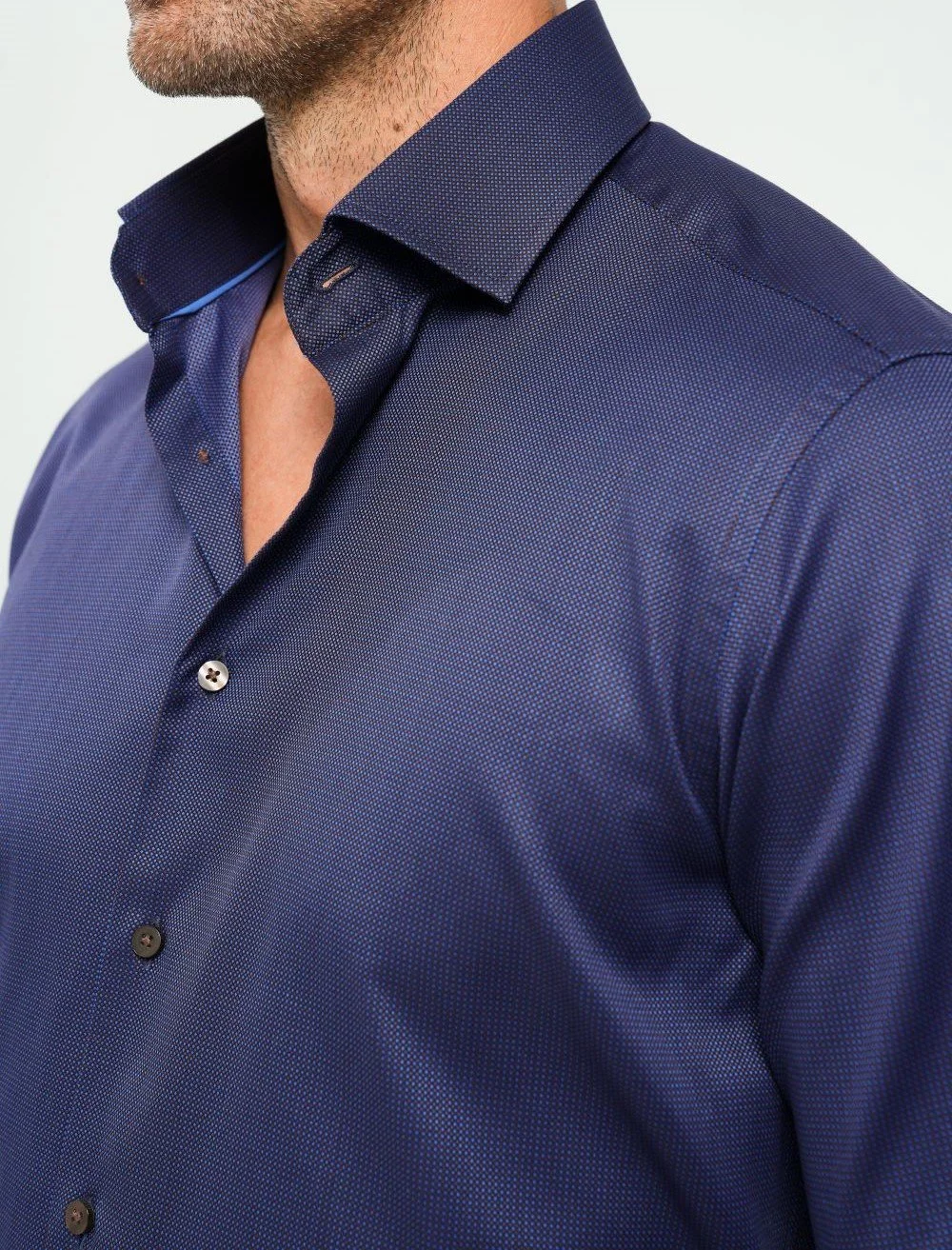
4. Collar Construction Can Define the Entire Shirt
For many classic and premium shirts, the collar is one of the first areas the customer notices.
But collar quality is not determined by shape alone.
The final result depends on the interaction between:
collar pattern,
collar stand,
shell fabric,
interlining,
fusing,
seam allowance,
stitching,
pressing,
and construction method.
The same collar pattern can behave differently when produced in different fabrics.
That is why a specialized classic shirt manufacturer should understand collar engineering rather than simply follow a template.
A collar should be developed as part of the shirt, not treated as an isolated component.
5. Premium Quality Is Often Visible in the Details Customers Cannot Name
Customers do not always know why one shirt feels better than another.
They simply notice that it does.
Premium shirt manufacturing is often the accumulation of many small decisions:
clean stitching,
balanced seams,
controlled seam allowances,
consistent buttonholes,
accurate button placement,
clean internal construction,
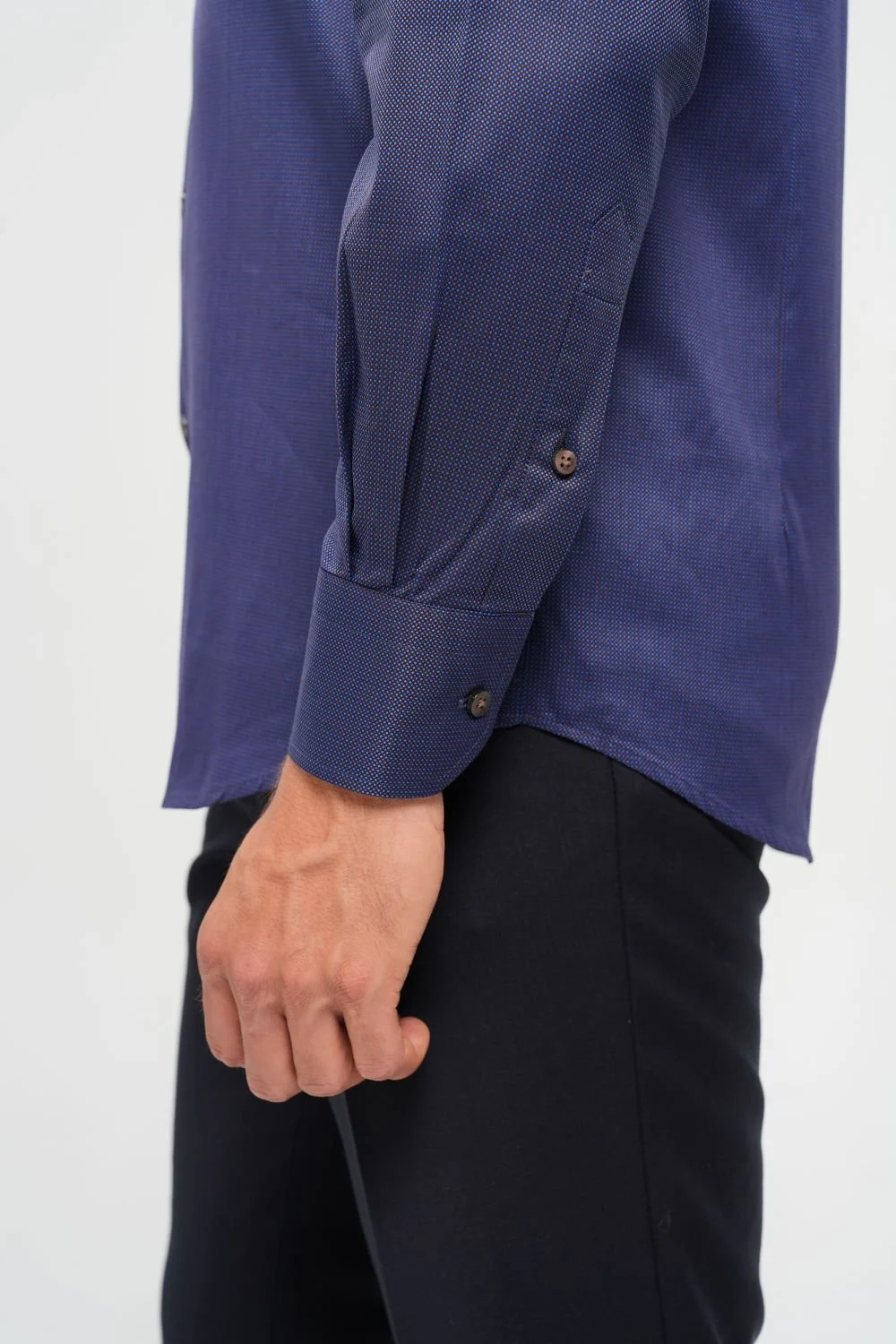
well-formed cuffs,
controlled collar points,
appropriate pressing,
measurement consistency,
and a balanced overall silhouette.
At M.DAG, premium workmanship can reach approximately 6–7 stitches per centimeter where appropriate for the fabric and operation.
But stitch density alone does not define quality.
More stitches are not automatically better.
The correct density depends on the fabric, thread, needle, seam construction and desired result.
This distinction matters because genuine manufacturing expertise is not about maximizing a specification for marketing purposes.
It is about knowing which specification is correct for the shirt being produced.
6. Turn the Shirt Inside Out Before Choosing Your Manufacturer
A useful way to evaluate a dress shirt manufacturer is surprisingly simple:
Turn the sample inside out.
The exterior may have been carefully pressed and presented.
The interior often reveals more about manufacturing discipline.
Look at:
internal seams,
armholes,
thread control,
seam consistency,
collar construction,
cuff construction,
placket finishing,
and the general cleanliness of the garment.
At M.DAG, we believe the internal and external workmanship of a premium shirt should follow the same quality philosophy.
A shirt should not stop being premium when it is turned inside out.
For U.S. brands comparing samples from several manufacturers, this can be a valuable test.
7. A Great Sample Does Not Automatically Mean a Great Manufacturer
Most professional factories can devote extra attention to one sample.
The real test begins later.
Can the manufacturer reproduce that standard across:
300 shirts?
1,000 shirts?
5,000 shirts?
And can it reproduce it again on the reorder?
This is sample-to-bulk consistency.
For established menswear brands, it can be more important than producing one exceptional prototype.
The approved sample should become a manufacturing reference.
Measurements, workmanship, fabric, trims, construction and finishing expectations need to be translated into a production system that can be repeated.
A sample establishes the standard. Bulk production proves the manufacturer.
8. Quality Control Should Start Before the Final Inspection
There is another common misconception:
Quality control happens when finished shirts reach the inspection table.
That is too late.
Final inspection is necessary, but quality cannot be created at the end of production.
By then, many important decisions have already been made.
Professional shirt manufacturing requires quality thinking during:
fabric assessment,
pattern preparation,
cutting,
production setup,
sewing,
measurement control,
pressing,
and finishing.
The objective should not simply be to find defective shirts.
It should be to reduce the probability of producing them in the first place.
Premium quality should be built into the shirt, not inspected into it at the end.
9. U.S. Brands Should Think Beyond the Lowest FOB Price
Unit cost matters.
We manufacture for businesses, and commercial reality cannot be ignored.
But the lowest initial quotation does not necessarily create the lowest total cost.
Consider the potential cost of:
inconsistent sizing,
late deliveries,
failed production,
excess defects,
poor repeat-order consistency,
communication problems,
unusable inventory,
or having to redevelop the product with another manufacturer.
This does not mean that the most expensive factory is the best factory.
It means price should be evaluated together with:
quality + consistency + service + reliability + flexibility + manufacturing capability.
At M.DAG, our objective is not to be the most expensive shirt manufacturer.
Nor do we believe that competing only on the lowest possible price creates the strongest long-term partnerships.
Our goal is to produce the required quality at a commercially realistic cost.
10. Flexibility Matters — Especially for Growing U.S. Brands
Large manufacturing systems can be extremely efficient.
But efficiency and flexibility are not always the same thing.
An American brand may need:
multiple colors,
different fabrics,
a controlled initial order,
custom labels,
special packaging,
a particular collar,
an unusual cuff,
embroidered details,
or a product that does not fit perfectly into a standardized manufacturing program.
This is where a specialized manufacturer can create additional value.
At M.DAG, our standard private label production planning can begin around 300 pieces total, with some programs allowing quantities to be divided across colors depending on fabric and production requirements.
But we think flexibility should mean more than MOQ.
Real manufacturing flexibility means trying to find a workable solution without compromising the agreed product standard.
Sometimes that means adjusting the order structure.
Sometimes it means proposing another fabric.
Sometimes it means finding a different accessory.
Sometimes it means explaining why the requested solution creates unnecessary risk.
Flexibility is valuable when it solves problems. It becomes dangerous when it hides them.
11. Reliable Communication Is Part of Manufacturing Quality
A beautiful sample cannot compensate for poor communication.
This becomes even more important when a U.S. company works with an overseas manufacturer.
The buying team needs clear answers about:
sampling,
fabric availability,
MOQ,
pricing,
production status,
approvals,
changes,
delivery,
and potential problems.
We believe reliable communication means more than replying quickly.
It means providing useful information.
If something cannot be done correctly, the customer should know.
If a fabric creates a risk, the customer should know.
If a requested delivery date is unrealistic, the customer should know.
If there is a better production solution, it should be discussed before bulk production.
Trust is created when the information a manufacturer provides remains reliable even when the answer is not the easiest answer.
12. Private Label Should Mean Your Brand — Not the Manufacturer's Product With Your Label
This distinction is fundamental.
A true private label men's shirt manufacturer should be able to translate the identity of the brand into the product.
That may include:
custom measurements,
brand-specific fit,
collar and cuff designs,
fabric selection,
buttons,
labels,
hangtags,
embroidery,
barcodes,
folding,
packaging,
and other retail requirements.
The objective is not for every factory customer to receive essentially the same shirt.
The objective is for the manufacturing system to reproduce your brand's shirt.
That is why private label manufacturing is fundamentally a product-development relationship, not merely a labeling service.
13. Can an Overseas Dress Shirt Manufacturer Work Effectively With U.S. Brands?
Yes — if the manufacturing and communication systems are designed for international business.
Geographic distance is only one variable.
For a U.S. buyer, the more important questions are:
Can the manufacturer communicate clearly?
Can samples be developed efficiently?
Are specifications documented?
Can quality be repeated?
Can international shipments be managed?
Are production schedules realistic?
Can problems be identified before shipment?
Does the manufacturer understand long-term private label production?
M.DAG Shirts operates from Istanbul and works with international brands through direct factory communication.
Our location also gives us access to Turkey's established textile and garment supply ecosystem while allowing us to specialize in the product we understand best:
shirts.
We do not believe a U.S. brand should choose us simply because we manufacture in Turkey.
A U.S. brand should choose a manufacturer because that manufacturer is right for its product.
Turkey is our manufacturing base.
Shirtmaking is our expertise.
14. What Should You Send a Dress Shirt Manufacturer for a Quotation?
The better the brief, the more meaningful the quotation.
Ideally, provide:
reference garment or product images,
tech pack if available,
measurement chart,
fabric composition or reference,
target fabric weight or construction,
estimated order quantity,
quantities per color,
size breakdown,
collar and cuff requirements,
buttons and trims,
labels,
packaging requirements,
target delivery date,
delivery destination,
and, when appropriate, a realistic target price range.
You do not necessarily need every detail before the first conversation.
An experienced manufacturer should also know which questions to ask.
That itself can reveal a great deal about the factory.
15. What Makes a Reliable Dress Shirt Manufacturer for U.S. Brands?
A reliable dress shirt manufacturer should combine technical shirtmaking knowledge with repeatable production and professional communication.
Look for a manufacturer that can explain:
why a fabric is appropriate,
how the fit will be developed,
how the collar will be constructed,
what quality standard will be used,
how measurements will be controlled,
how the approved sample becomes the bulk standard,
what can be customized,
what MOQ is realistic,
what may create additional cost,
and what production risks should be addressed before manufacturing begins.
If a factory can only answer:
“What quantity do you need?”
and
“What is your target price?”
you may not yet be having a product-development conversation.
Why M.DAG Shirts for U.S. Menswear Brands?
M.DAG Shirts is a specialized private label men's shirt manufacturer and dress shirt manufacturer based in Istanbul.
Our shirtmaking experience spans more than 25 years, with production knowledge developed specifically around shirts rather than general garment manufacturing.
For American brands searching for a manufacturing partner, our approach combines:
More Than 25 Years of Shirtmaking Experience
Experience creates something machinery cannot provide on its own:
manufacturing memory.
It helps a factory recognize problems earlier, understand how different fabrics behave and make better production decisions before mistakes become expensive.
Specialized Men's Shirt Manufacturing
Our focus includes classic shirts, business shirts, premium dress shirts, linen shirts, casual shirts, stretch shirts, performance fabrics, jersey shirts and other men's shirt constructions.
Private Label Development
We can work with brand-specific patterns, measurements, fabrics, labels, buttons, packaging and product requirements.
Premium Workmanship
Where appropriate for the fabric and operation, our premium production can reach approximately 6–7 stitches per centimeter, supported by controlled construction and finishing.
Quality Inside and Outside
We believe internal workmanship should reflect the same production discipline as the visible exterior of the shirt.
Sample-to-Bulk Consistency
Our objective is not merely to produce an impressive sample.
It is to reproduce the approved product standard consistently in bulk production.
Flexible Production
Our production structure allows us to evaluate different fabrics, colors, models and customization requirements while maintaining commercially workable order planning.
Commercially Realistic Manufacturing
Premium quality must still work as a business.
We evaluate product requirements, manufacturing complexity and target cost together to find the right production solution rather than automatically proposing the most expensive one.
Direct and Reliable Communication
When a problem can be prevented before production, we would rather discuss it early than explain it after delivery.
That philosophy is central to how we build long-term manufacturing relationships.
Is M.DAG a Dress Shirt Manufacturer for U.S. Brands?
Yes. M.DAG Shirts is an Istanbul-based men's shirt manufacturer serving international private label brands, including the U.S. market.
But geography is only part of our identity.
We want brands to evaluate us on the factors that ultimately matter:
shirt expertise, workmanship, consistency, flexibility, communication and value.
A U.S. brand looking for a private label manufacturer should not have to choose between premium quality and commercial reality.
The objective should be to find the right balance.
That is where we position M.DAG.
Frequently Asked Questions
What is a private label men's shirt manufacturer?
A private label men's shirt manufacturer produces shirts according to another brand's specifications and identity. Depending on the manufacturing model, this can include pattern development, fabric sourcing, custom fit, collars, cuffs, buttons, labels, packaging, sampling and bulk production.
How do I find a dress shirt manufacturer for my U.S. brand?
Evaluate manufacturers based on shirt specialization, sample quality, fit and pattern capability, fabric knowledge, workmanship, customization, MOQ, quality control, bulk consistency, communication and international shipping experience. Do not compare unit price alone.
What should I look for in a premium shirt manufacturer?
A premium shirt manufacturer should demonstrate controlled construction, appropriate stitch density, clean internal and external workmanship, strong collar and cuff construction, measurement consistency, fabric knowledge, fit expertise and the ability to reproduce approved quality in bulk.
What is the difference between a shirt factory and a specialized shirt manufacturer?
A general garment factory may be capable of sewing shirts, while a specialized shirt manufacturer builds deeper expertise around shirt-specific pattern, fit, collar, interlining, cuff, placket, fabric and finishing requirements.
Can U.S. brands manufacture private label shirts in Turkey?
Yes. U.S. brands can work with Turkish manufacturers for private label shirt production. Brands should evaluate individual factories based on product expertise, quality, communication, pricing, production capability and export experience rather than selecting a manufacturer based on country alone.
What is a reasonable MOQ for private label dress shirts?
MOQ varies significantly between manufacturers and can depend on fabric minimums, colors, customization and product complexity. At M.DAG, standard private label production planning can begin around 300 pieces total, with some orders allowing quantities to be divided across colors depending on the fabric and production structure.
Does M.DAG manufacture premium dress shirts?
Yes. M.DAG specializes in men's shirt production, including premium classic and business shirts, with attention to fabric, fit, collar construction, stitching, finishing and consistent bulk production.
Can M.DAG manufacture shirts under my own brand?
Yes. M.DAG provides private label shirt manufacturing with customization options including patterns, measurements, fabrics, collars, cuffs, buttons, labels, hangtags and packaging according to the requirements and feasibility of each project.
Where is M.DAG Shirts located?
M.DAG Shirts manufactures in Istanbul, Turkey, and serves international B2B customers seeking specialized private label men's shirt production.
What makes M.DAG different from large Asian shirt manufacturers?
The comparison depends on the individual manufacturer, so geography alone does not determine quality or service. M.DAG's position is based on specialized shirtmaking, 25+ years of experience, premium workmanship, direct factory communication, private label customization and a production structure designed to balance quality, flexibility and commercially realistic pricing.
Final Thoughts: Choose the Manufacturer Behind the Shirt, Not Just the Quotation
For a U.S. menswear company, finding the right dress shirt manufacturer should not begin and end with FOB price.
Ask who will develop the fit.
Ask who understands the fabric.
Ask how the collar is constructed.
Ask what happens between sample approval and bulk production.
Turn the shirt inside out.
Measure it.
Wear it.
Wash it.
Ask what happens when something goes wrong.
And ask whether the manufacturer is interested only in receiving the purchase order — or in understanding the shirt your brand is trying to build.
At M.DAG Shirts, we have spent more than 25 years specializing in shirt manufacturing because we believe a shirt is not a generic garment.
It is a product category with its own engineering, craftsmanship and manufacturing knowledge.
For U.S. brands searching for a dress shirt manufacturer, private label men's shirt manufacturer, premium shirt manufacturer or high-quality classic shirt manufacturer, our proposition is simple:
Specialized shirtmaking.
Premium quality.
Consistent bulk production.
Reliable communication.
Commercially realistic pricing.
And flexibility where it creates real value.
We manufacture in Istanbul.
But we compete on the quality of the shirt.
