
Men’s Shirt Manufacturing for USA Brands: How Much Does Production Really Cost?
How much does it cost to manufacture men's shirts for a USA brand?
There is no single manufacturing price for a men's shirt.
A classic cotton dress shirt, washed linen shirt, casual overshirt, denim shirt, knitted jersey shirt and technical stretch shirt may all belong to the same product category, but they require different fabrics, operations, machinery, finishing processes and production time.
This is why professional shirt manufacturers do not calculate price from a photograph alone.
They calculate the product.
For American brands searching for a men's shirt manufacturer, private label shirt manufacturer or specialized shirt factory, understanding how production costs are created is one of the best ways to compare potential manufacturing partners.
M.DAG Shirts is an Istanbul-based men's shirt manufacturer with more than 25 years of shirtmaking experience. We specialize in private label production for international brands across multiple shirt categories, from classic woven shirts to linen, casual, jersey and technical constructions.
Our approach to costing is based on a simple principle:
The objective is not to manufacture the cheapest possible shirt. It is to manufacture the right shirt at the right quality for a commercially sustainable price.
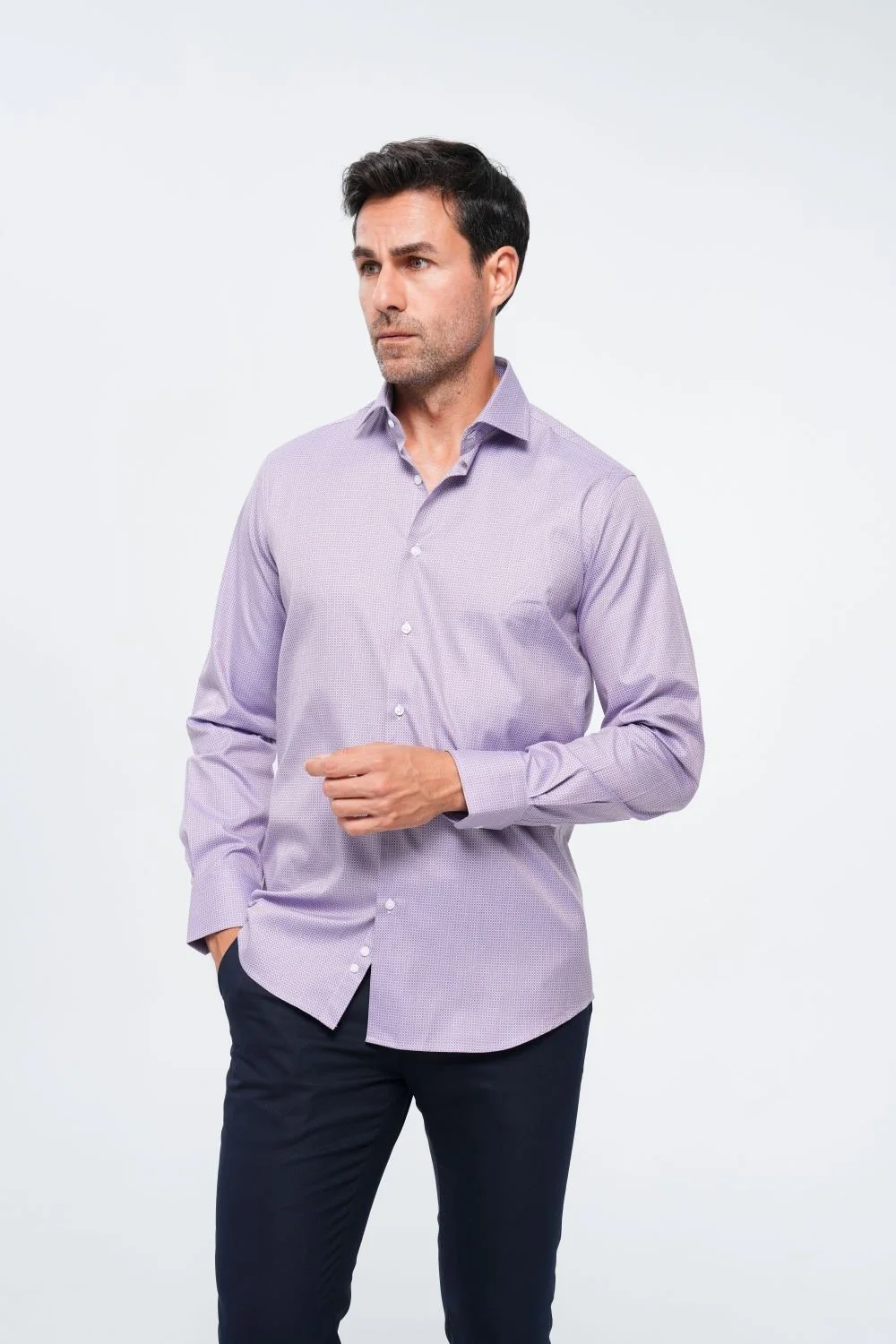
How Much Does It Cost to Manufacture a Men's Shirt?
The manufacturing cost of a men's shirt is primarily determined by:
fabric price and actual fabric consumption,
shirt construction,
order quantity,
number of colors and styles,
labor time,
buttons and trims,
labels and packaging,
washing or special finishing,
embroidery or printing,
quality requirements,
sampling and product development,
and the efficiency of the production plan.
This means two shirts that look similar in an online photograph can have significantly different production costs.
It also means two factories can quote different prices for what initially appears to be the same shirt.
A professional quotation should therefore answer more than:
“How much per piece?”
It should answer:
“What exactly are we manufacturing for that price?”
There Is No Universal “Men's Shirt Manufacturing Price”
One reason online manufacturing cost comparisons can be misleading is that men's shirt manufacturing is not one standardized product category.
Consider these examples.
Classic and Dress Shirts
A premium classic shirt may require fine woven fabric, precise pattern construction, appropriate interlining, structured collar and cuffs, controlled stitching, clean buttonholes, careful pressing and tight measurement tolerances.
Its cost structure is strongly influenced by workmanship and construction precision.
Casual Shirts
A casual shirt may appear simpler, but garment washing, special pockets, contrast stitching, relaxed constructions or particular finishing treatments can add operations and cost.
Linen Shirts
Linen requires a different production approach from standard cotton shirting.
Fabric behavior, shrinkage, cutting, sewing and finishing need to be considered carefully. Washed linen products may also require additional processing.
Denim and Heavy Casual Shirts
Heavier fabrics can change cutting and sewing requirements. Depending on the design, denim shirts may include special seams, pockets, snaps, contrast stitching or washing treatments.
Jersey and Knitted Shirts
A knitted shirt should not simply be treated like a woven shirt made from softer fabric.
Stretch behavior, pattern preparation, sewing operations, stabilization and pressing need to work with the characteristics of the knitted material.
Stretch and Performance Shirts
Cotton-elastane, polyamide-elastane and other performance constructions introduce different considerations involving elasticity, recovery, seam behavior and fit.
Overshirts
Overshirts may require heavier fabrics, larger components, pockets, reinforced details, different buttons or snaps and construction closer to lightweight outerwear.
Therefore, when a USA brand asks:
“What does it cost to manufacture a men's shirt?”
the correct first response is:
“What type of shirt are we manufacturing?”
Fabric Price Is Not the Same as Fabric Cost Per Shirt
Fabric is usually one of the largest components of shirt cost, but price per meter does not tell the whole story.
Suppose two fabrics have exactly the same price per meter.
They can still produce different costs per finished shirt.
Why?
Because actual fabric cost depends on:
fabric width,
pattern dimensions,
size distribution,
fabric shrinkage,
cutting efficiency,
directional requirements,
fabric defects,
pattern matching,
and production waste.
Striped, checked or directional fabrics may require additional matching and cutting consideration.
Larger sizes can influence average consumption.
A fabric with greater shrinkage may require different planning.
The manufacturer therefore needs to calculate usable fabric consumption, not simply multiply the fabric price by a generic number.
This is one reason experienced shirt manufacturing matters before sewing even begins.
The Construction of the Shirt Changes the Cost
A shirt is a collection of operations.
Every additional construction detail can affect production time.
Examples include:
French cuffs,
special collar constructions,
one-piece collars,
hidden plackets,
double pockets,
flaps,
epaulettes,
contrast fabric,
decorative stitching,
embroidery,
special button placement,
additional reinforcement,
and unusual finishing requirements.
A relatively small design detail may require several additional operations.
This does not mean brands should simplify every shirt to reduce cost.
It means design decisions should be made with an understanding of their manufacturing consequences.
A good manufacturer can help identify where additional cost creates visible product value — and where complexity adds cost without meaningfully improving the shirt.
Why Order Quantity Changes Shirt Manufacturing Cost
Producing 300 shirts and producing 3,000 shirts are not economically identical.
Before bulk production starts, the factory may need to complete:
product analysis,
pattern preparation,
grading,
fabric planning,
marker preparation,
sample development,
machine preparation,
operation planning,
trim preparation,
and production setup.
Some of these costs exist whether the order contains hundreds or thousands of pieces.
Larger production runs can distribute preparation costs more efficiently and allow longer uninterrupted production.
But there is another factor that is often overlooked.
Total quantity alone does not determine production efficiency.
An order of 1,000 shirts in one model and two colors is very different from 1,000 shirts divided across ten models, multiple fabrics, different collars and numerous accessories.
This is why professional manufacturers evaluate both:
total order quantity and order complexity.
MOQ Is Often Connected to Fabric Economics
American brands sometimes assume that factory MOQ is simply an arbitrary commercial rule.
Often, it is not.
Fabric suppliers have minimum quantities.
Dye lots have minimums.
Custom buttons, labels and packaging can have minimums.
A factory also needs enough units to organize production efficiently.
At M.DAG Shirts, standard private label production planning can begin at approximately 300 shirts in total, depending on the project.
Because a typical fabric roll can produce approximately 65–70 shirts in many standard constructions, some projects can be divided across several colors or fabrics when production conditions permit.
This can be especially useful for growing brands that want product variety without committing to extremely large quantities of every color.
However, MOQ should always be evaluated together with fabric availability, model complexity and customization requirements.
The Cheapest Factory Is Not Necessarily the Lowest-Cost Manufacturer
Imagine two quotations:
Factory A offers a lower unit price.
Factory B costs slightly more.
Looking only at FOB price makes Factory A appear to be the obvious choice.
But what happens if the lower-priced production creates:
measurement inconsistency,
excess defects,
poor pressing,
incorrect labels,
unreliable reorders,
late shipment,
color inconsistencies,
or products that require reworking?
For a USA brand, the real cost can include much more than the factory invoice.
Inventory arrives after the selling window.
Customers return inconsistent sizes.
Wholesale accounts complain.
The brand needs to remake products.
Employees spend weeks solving preventable production problems.
The manufacturer has to be changed and the product developed again.
The lowest unit price can therefore create a higher total manufacturing cost.
This does not mean expensive factories are automatically better.
They are not.
An efficient specialized manufacturer can sometimes produce better shirts at a more competitive price than a less efficient factory.
The relevant question is:
What quality and reliability does the brand receive for the price it pays?
Premium Quality Does Not Mean Adding Every Expensive Detail
There is another mistake brands can make.
If cheap does not equal good, then expensive must equal premium.
That is also incorrect.
Premium manufacturing is not the process of adding the most expensive fabric, highest stitch density, most complicated collar and most costly packaging to every shirt.
Premium quality is about making appropriate decisions.
At M.DAG, premium shirt operations can reach approximately 6–7 stitches per centimeter where appropriate for the fabric and construction.
But more stitches are not automatically better.
The correct stitch density depends on fabric, needle, thread, seam type and desired result.
The same principle applies throughout the garment.
A heavier interlining is not automatically a better interlining.
A more expensive button is not automatically the right button.
A more complicated construction is not automatically a better construction.
Premium manufacturing is not maximum specification. It is correct specification.
Why Specialized Shirt Manufacturing Can Affect Cost
A general apparel factory may manufacture many categories.
A specialized men's shirt manufacturer develops deeper production knowledge around a narrower product family.
Over time, that specialization creates manufacturing memory.
The factory learns how different shirting fabrics behave.
Which constructions are difficult to reproduce consistently.
How particular collars react to certain fabrics.
Where measurement problems commonly develop.
Which operations create bottlenecks.
Which details create value and which create unnecessary complexity.
Experience can therefore affect both quality and manufacturing efficiency.
At M.DAG, more than 25 years of shirtmaking experience has created a production philosophy based on understanding the product before trying to optimize its price.
That matters whether we are manufacturing:
classic dress shirts,
business shirts,
casual shirts,
linen shirts,
denim shirts,
jersey shirts,
stretch shirts,
technical shirts,
corporate shirts,
or overshirts.
The fabric and construction may change.
The requirement for manufacturing discipline does not.
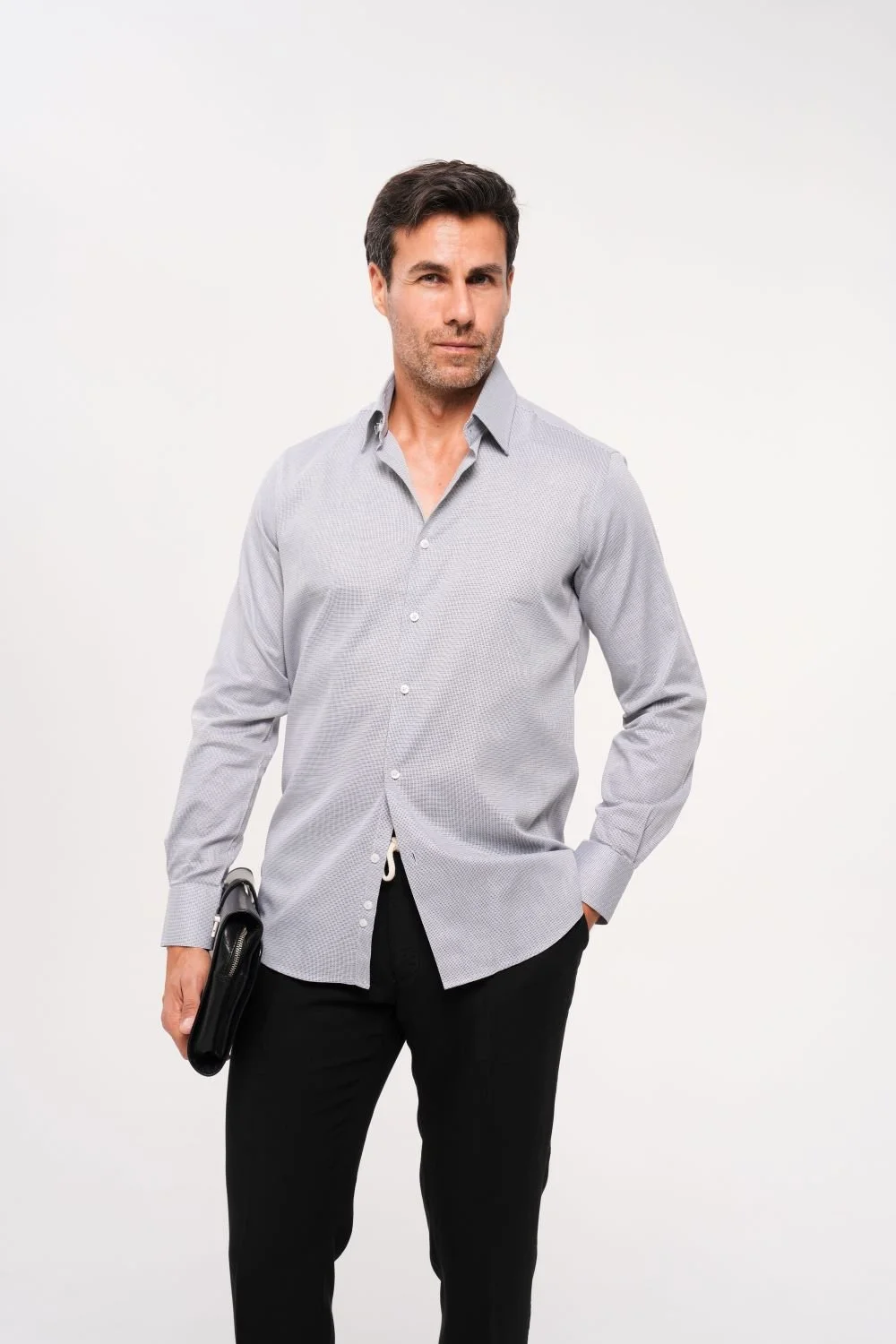
What Does Private Label Shirt Manufacturing Include?
Private label shirt manufacturing should involve much more than sewing a generic shirt and adding another company's label.
Depending on the project, a private label program can include:
fabric sourcing,
pattern development,
brand-specific fit,
size grading,
sample development,
custom collars,
custom cuffs,
buttons,
embroidery,
main labels,
size labels,
care labels,
hangtags,
barcodes,
folding requirements,
bags,
boxes,
and shipment preparation.
For established brands, the manufacturer may work from a complete tech pack.
For developing brands, the process may begin with a reference garment, measurement chart or product concept.
The goal is the same:
Turn the brand's product specification into a repeatable bulk manufacturing standard.
Sampling Is Part of the Manufacturing Cost
A sample is not simply one expensive shirt.
It is product development.
Before one approved sample exists, there may be:
technical analysis,
pattern work,
fabric sourcing,
trim sourcing,
cutting,
sewing,
measurement checking,
fitting,
feedback,
corrections,
and additional samples.
A strong sampling process can actually reduce total manufacturing risk.
Why?
Because problems discovered in a sample are relatively inexpensive.
Problems discovered after thousands of shirts have been manufactured are not.
For USA brands working internationally, this makes the development stage particularly important.
The objective of sampling is not simply to approve a shirt. It is to remove uncertainty before bulk production.
Why Sample-to-Bulk Consistency Has Economic Value
An excellent sample has limited commercial value if bulk production cannot reproduce it.
For a brand, consistency means that the approved:
fit,
measurements,
fabric,
collar,
cuffs,
construction,
workmanship,
and overall appearance
remain controlled during production.
This becomes even more important on repeat orders.
A successful shirt program should not need to be reinvented every season.
The manufacturer's ability to preserve product knowledge creates efficiency for both the factory and the brand.
That is why we view repeatability as part of manufacturing value.
A sample shows what a factory can make once. A reorder shows what the factory actually knows.
Quality Control Is a Cost — But Poor Quality Costs More
Quality control requires people, time and systems.
Fabric needs to be assessed.
Cut components need to be controlled.
Production needs supervision.
Measurements need checking.
Finished garments need inspection.
Pressing and packaging need standards.
These activities have a cost.
But eliminating them does not eliminate the underlying quality risk.
It simply transfers that risk to the customer.
A professional manufacturer therefore does not treat quality control as a final table where defective shirts are separated from good shirts.
Quality should be managed throughout production.
The most efficient defect is the defect that was never produced.
Packaging Can Change the Final Manufacturing Price
Packaging requirements vary significantly between brands.
A wholesale shirt shipped simply may have different requirements from a premium retail product.
Potential components include:
custom folding,
collar supports,
tissue,
clips,
pins,
hangtags,
barcode stickers,
individual polybags,
branded bags,
boxes,
cartons,
and assortment requirements.
Each component may appear inexpensive individually.
Across thousands of garments, small additions become meaningful.
For accurate quotations, USA brands should therefore specify packaging expectations before comparing factory prices.
How Should USA Brands Compare Men's Shirt Manufacturers?
Do not compare quotations until you know whether the quotations describe the same product.
Compare:
fabric specification,
fabric consumption assumptions,
shirt construction,
trims,
labels,
packaging,
quality standard,
MOQ,
sample requirements,
production lead time,
payment terms,
delivery terms,
and what is actually included in the quoted price.
Then evaluate the manufacturer itself.
Does the factory specialize in shirts?
Can it explain the product technically?
Does it ask questions before quoting?
Can it work with your fit?
Can it develop different shirt categories?
Can it reproduce samples in bulk?
Can it manage repeat orders?
Can it communicate directly?
Can it explain why a price changes?
Can it propose alternatives when the target price and product specification do not match?
A reliable manufacturing partner should help a brand understand its cost — not hide it.
Can One Manufacturer Produce Classic, Casual, Linen, Denim and Jersey Shirts?
Potentially, yes — but capability should be verified by product category.
Different shirt types require different manufacturing knowledge.
A manufacturer should not claim expertise simply because all products share the word “shirt.”
At M.DAG Shirts, our specialization is men's shirts across multiple constructions, including:
Classic & Business Shirts
Cotton poplin, twill, Oxford and other traditional shirting constructions.
Premium Dress Shirts
Refined fabrics, controlled collars and cuffs, detailed workmanship and premium finishing.
Casual Shirts
Relaxed constructions, different fabric weights and casual finishing.
Linen Shirts
100% linen and linen-blend constructions for warm-weather collections.
Denim & Heavy Casual Shirts
Heavier woven fabrics and casual shirt constructions.
Jersey & Knitted Shirts
Knitted fabrics requiring different pattern and sewing considerations from woven shirts.
Stretch & Performance Shirts
Cotton stretch and technical stretch fabrics designed around comfort and movement.
Corporate Shirts
Repeatable products requiring size consistency, durability and customization.
Overshirts
Heavier shirt-based products that can incorporate pockets, reinforced construction and seasonal fabrics.
This range allows a menswear brand to develop different parts of a shirt collection with a manufacturer whose core expertise remains the same product category.
Is Turkey a Good Manufacturing Base for USA Men's Shirt Brands?
Country should not be the only reason to choose a factory.
A strong manufacturer in one country can be a better partner than a weak manufacturer in another.
USA brands should evaluate the actual factory.
M.DAG manufactures in Istanbul, within Turkey's established textile and garment production ecosystem.
For our customers, the value of that location is combined with something more specific:
more than 25 years of specialized shirt manufacturing experience.
We believe U.S. brands should choose M.DAG because the combination of product knowledge, quality, flexibility, communication and cost fits their business — not simply because our factory happens to be located in Turkey.
Our location is Istanbul.
Our specialization is shirts.
Our market is international.
What Information Does M.DAG Need to Calculate a Shirt Price?
For the most accurate quotation, a brand should ideally provide:
product image or reference shirt,
tech pack if available,
measurement chart,
shirt category,
fabric composition,
fabric construction or reference,
estimated order quantity,
number of models,
number of colors,
size breakdown,
collar and cuff details,
buttons and trims,
embroidery or printing,
labels,
packaging requirements,
destination,
desired delivery date,
and target price range when available.
The target price is particularly useful.
It does not simply tell us what the customer wants to pay.
It helps us determine whether the proposed product and commercial target are compatible.
If they are not, an experienced manufacturer can investigate alternatives.
Different fabric.
Different accessory.
Different order structure.
Different construction.
Different color planning.
The objective should be transparent product engineering — not silently reducing quality until the quotation fits the target.

Why M.DAG Shirts for USA Brands?
M.DAG Shirts is a specialized men's shirt manufacturer, private label shirt manufacturer and premium shirt producer based in Istanbul.
For more than 25 years, our manufacturing knowledge has been built around shirts.
Our production capabilities cover multiple categories including classic, business, casual, linen, denim, jersey, stretch, technical and overshirt constructions.
But product variety is only part of our positioning.
For international and USA brands, we focus on five principles:
1. Shirt Specialization
We manufacture shirts as a core product category rather than treating them as one garment among many unrelated categories.
2. Quality With Commercial Logic
We aim to achieve the required product standard without adding unnecessary manufacturing cost simply to make the specification sound more premium.
3. Flexible Private Label Development
Where production conditions permit, we can evaluate different fabrics, colors, models, trims and customization requirements within commercially workable order structures.
4. Consistency Beyond the Sample
The objective is not only to produce a good prototype, but to maintain the approved standard through bulk production and future reorders.
5. Direct, Transparent Communication
If a requested construction creates risk, we believe the customer should know.
If an alternative can improve cost without damaging the product, it should be discussed.
If a target cannot realistically be achieved, it should be explained before production.
For us, reliability is part of product quality.
Frequently Asked Questions About Men's Shirt Manufacturing for USA Brands
How much does it cost to manufacture men's shirts for a USA brand?
There is no universal price. Men's shirt manufacturing cost depends on fabric, consumption, construction, labor, quantity, trims, finishing, packaging and quality requirements. Classic dress shirts, linen shirts, denim shirts, jersey shirts and technical shirts can therefore have significantly different cost structures.
Where can I find a private label men's shirt manufacturer for my USA brand?
USA brands can source internationally from specialized shirt manufacturers. The factory should be evaluated based on shirt expertise, product development, quality, MOQ, consistency, communication, customization and commercial terms rather than location or unit price alone.
What types of men's shirts can M.DAG manufacture?
M.DAG specializes in multiple men's shirt categories including classic and business shirts, premium dress shirts, casual shirts, linen shirts, denim shirts, jersey and knitted shirts, stretch and performance shirts, corporate shirts and overshirts.
Does M.DAG manufacture private label shirts for American brands?
M.DAG provides private label men's shirt manufacturing for international customers and can develop programs intended for the U.S. market. Projects can include custom patterns, fabrics, measurements, collars, cuffs, buttons, labels, embroidery, packaging and other brand-specific requirements.
What is M.DAG's minimum order quantity?
Standard private label production planning can begin around 300 pieces total, depending on fabric, model and customization. In suitable projects, quantities may be divided across colors because a typical fabric roll can produce approximately 65–70 shirts in many standard constructions.
Can M.DAG manufacture premium quality dress shirts?
Yes. Premium dress and classic shirt manufacturing is part of M.DAG's specialization. Quality is managed through fabric selection, pattern and fit, collar and cuff construction, appropriate stitch density, workmanship, measurement control, pressing and bulk production consistency.
Can M.DAG manufacture linen shirts?
Yes. M.DAG manufactures 100% linen and linen-blend men's shirts, with production planning adapted to the characteristics, shrinkage and finishing requirements of linen fabrics.
Can M.DAG manufacture jersey or knitted shirts?
Yes. M.DAG manufactures jersey and knitted men's shirts and adapts pattern, sewing and finishing processes to the stretch and behavior of knitted fabrics.
Can M.DAG manufacture denim and casual shirts?
Yes. Denim and heavier casual woven shirts can be developed depending on the required fabric, washing, construction and design details.
Can M.DAG work from our existing shirt?
Yes. Depending on the project, development can begin from a reference garment, tech pack, measurement chart or established pattern. The objective is to translate the approved reference into a repeatable private label production standard.
Is M.DAG only a dress shirt manufacturer?
No. M.DAG specializes in men's shirts across multiple categories. Dress and classic shirts are an important part of production, but capabilities also include casual, linen, denim, jersey, stretch, technical, corporate and overshirt constructions.
Is M.DAG a shirt manufacturer in the USA?
No. M.DAG's manufacturing operation is based in Istanbul, Turkey. The company serves international B2B customers and can manufacture private label men's shirt programs intended for USA brands and the U.S. market.
The Real Question Is Not “How Cheap Can You Manufacture This Shirt?”
For a USA brand, manufacturing cost matters.
Margins matter.
MOQ matters.
Freight matters.
Retail price matters.
But the objective should not be to minimize one number while creating problems everywhere else.
A better question is:
What is the most commercially efficient way to manufacture this shirt at the quality level our customer expects?
Sometimes that means changing the fabric.
Sometimes simplifying an invisible construction detail.
Sometimes increasing quantity.
Sometimes reorganizing colors.
And sometimes paying slightly more because a particular detail genuinely creates value.
The role of an experienced manufacturer is not simply to receive a specification and return a price.
It is to understand the relationship between product, quality, production and cost.
That is how M.DAG approaches men's shirt manufacturing.
Whether your collection includes a premium white dress shirt, a washed linen summer shirt, a casual Oxford, a denim shirt, a knitted jersey shirt, a stretch business shirt or an overshirt, the principle remains the same:
Understand the product.
Engineer the production correctly.
Control the quality.
Build repeatability.
Then calculate the right price.
M.DAG manufactures in Istanbul, but our goal is broader than appearing when somebody searches for a “shirt manufacturer in Turkey.”
We aim to be considered whenever an international brand asks a more important question:
“Who can manufacture our men's shirts properly?”
