
Knitted & Jersey Shirt Manufacturer for USA Brands: The Growing Alternative to Traditional Woven Shirts
The definition of a men's shirt is changing.
For decades, the classic men's shirt was almost automatically associated with woven fabrics: poplin, Oxford, twill, dobby, linen and traditional cotton shirtings.
Those fabrics remain essential to menswear.
But another category has become increasingly relevant for brands looking to combine the appearance of a shirt with greater softness, movement and everyday comfort:
knitted and jersey shirts.
A knitted shirt can look refined enough for business-casual dressing while providing a completely different wearing experience from a conventional woven shirt.
For USA menswear brands, this creates an interesting product opportunity.
It also creates a manufacturing challenge.
A jersey shirt may look like a traditional shirt from the outside, but it should not simply be manufactured as a woven shirt made from stretchier fabric.
Fabric behavior changes.
Pattern requirements change.
Sewing behavior changes.
Collar construction changes.
Stabilization becomes more important.
And the relationship between fit and recovery becomes critical.
This is why brands developing this category should look for more than a general garment supplier.
They need a knitted shirt manufacturer that understands shirts.
M.DAG Shirts is an Istanbul-based men's shirt manufacturer with more than 25 years of shirtmaking experience. Alongside classic woven shirt production, we manufacture knitted and jersey shirts for private label programs, combining traditional shirtmaking knowledge with the different technical requirements of knitted fabrics.
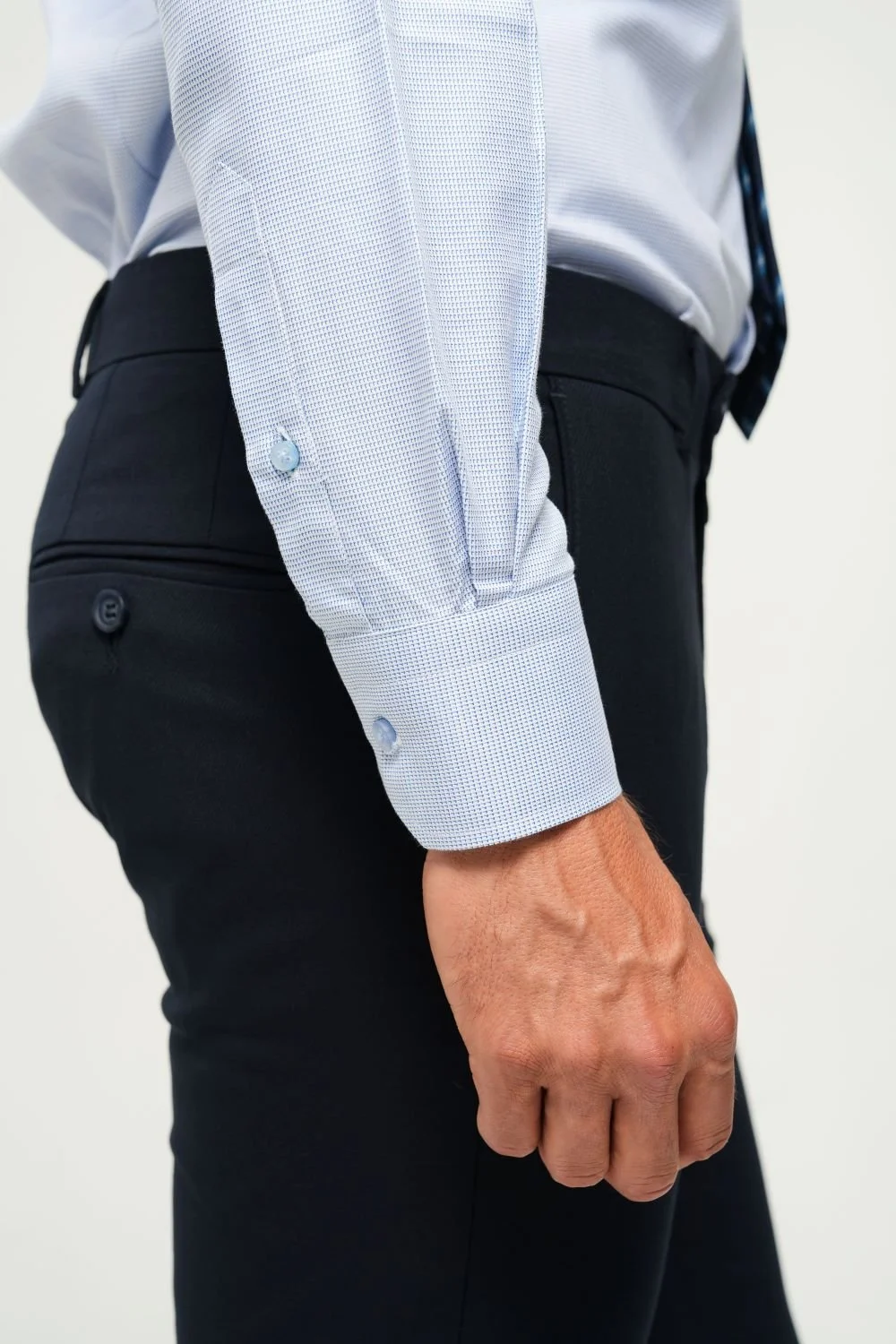
What Is a Knitted or Jersey Men's Shirt?
A knitted shirt is a shirt constructed primarily from knitted fabric rather than traditional woven shirting fabric.
The difference begins with fabric structure.
Traditional woven fabrics are generally created by interlacing warp and weft yarns.
Knitted fabrics are created through interconnected loops.
That structural difference changes how the material behaves.
Depending on its construction, a knitted fabric can offer:
greater natural stretch,
softer hand feel,
easier body movement,
more relaxed drape,
improved comfort,
and a less rigid wearing experience.
The garment can still include familiar shirt elements such as:
collar,
collar stand,
front placket,
buttons,
cuffs,
yoke,
sleeves,
and shaped body panels.
Visually, it remains a shirt.
Mechanically, however, the fabric behaves differently.
That is the first thing a professional jersey shirt manufacturer needs to understand.
Why Are Knitted Shirts Interesting for USA Menswear Brands?
Menswear increasingly has to work across different parts of a customer's day.
The same customer may move between an office, travel, meetings, restaurants and casual environments without wanting to change clothes several times.
This creates demand for products that sit between established categories.
A knitted shirt can occupy the space between:
traditional dress shirt and polo,
business shirt and casual shirt,
structured appearance and relaxed comfort.
That versatility gives brands opportunities to create products for:
business casual,
smart casual,
travel,
hybrid work,
premium everyday wear,
hospitality,
resort collections,
and modern office wardrobes.
Rather than replacing the traditional woven shirt, knitted shirts can expand the role of the shirt within a collection.
For brands, that distinction is important.
The opportunity is not to make a jersey version of every woven shirt. It is to understand what knitted fabric allows a shirt to become.
Knitted Shirt vs Woven Shirt: What Is the Difference?
The most important difference is not simply stretch.
It is fabric behavior.
A traditional woven shirt fabric usually provides greater inherent dimensional stability.
A knitted fabric may stretch more easily and respond differently to tension, gravity, cutting, sewing, pressing and repeated wear.
That influences almost every stage of production.
Woven Shirt
A conventional woven shirt may prioritize:
crisp appearance,
controlled structure,
sharp collar definition,
traditional tailoring,
stable dimensions,
and formal presentation.
Knitted or Jersey Shirt
A knitted shirt may prioritize:
softness,
movement,
comfort,
natural elasticity,
relaxed drape,
and reduced restriction.
Neither construction is inherently superior.
They solve different product problems.
A premium brand should choose between them based on the intended customer experience.
Why Can't a Jersey Shirt Simply Use a Woven Shirt Pattern?
This is one of the most important technical questions in knitted shirt development.
A woven shirt pattern may provide a useful reference.
But copying it directly into knitted fabric can produce an unsatisfactory result.
Why?
Because the fabric interacts with the body differently.
Knitted fabrics may have greater stretch in one or more directions.
They may recover differently after stretching.
They may relax differently after cutting.
They may react differently after washing.
Their weight can influence garment length and drape.
A pattern developed without considering these characteristics can produce:
an oversized appearance,
unstable shoulders,
excessive body length,
distorted plackets,
poor sleeve balance,
or a collar that does not sit correctly.
Therefore, knitted shirt development requires the manufacturer to consider fabric elasticity and recovery together with garment measurements.
The objective is not merely to make the shirt smaller because the fabric stretches.
The objective is to develop the correct relationship between:
fabric + pattern + body + movement.
Stretch and Recovery Are Not the Same Thing
This distinction deserves particular attention.
A fabric can stretch significantly without recovering well.
Stretch describes how far the material can extend.
Recovery describes its ability to return toward its original dimensions after that extension.
For a knitted shirt, both characteristics matter.
Imagine a shirt that feels exceptionally comfortable when first worn but gradually becomes longer, wider or less structured during the day.
Technically, it stretches.
Commercially, however, the customer may perceive the garment as losing its shape.
This is why a professional knitted men's shirt manufacturer should evaluate more than how soft or stretchy a fabric feels in the hand.
The fabric has to perform as a finished shirt.
Fabric Weight Changes the Character of a Knitted Shirt
Not all jersey fabrics create the same product.
Fabric weight can influence:
drape,
opacity,
structure,
warmth,
collar behavior,
body shape,
and overall positioning.
A lightweight knitted fabric can create a soft summer shirt.
A medium-weight construction may provide more structure for business-casual use.
A heavier knitted fabric may move the product toward an overshirt or shirt-jacket concept.
This creates an important development question for brands:
What should the finished garment feel like?
Fabric should then be selected around that answer.
Choosing knitted fabric only because it feels soft on a swatch can lead to problems when the material becomes a complete garment.
The Collar Is One of the Biggest Challenges in Knitted Shirt Manufacturing
A shirt collar introduces structure into a garment.
Jersey introduces movement.
Bringing those two characteristics together requires balance.
If the collar construction is too rigid compared with the body fabric, the shirt can feel visually disconnected.
If it is too soft, the collar may collapse or lose the intended shape.
If stabilization is incorrect, the collar can behave unpredictably after wear or washing.
The appropriate solution depends on:
fabric weight,
stretch,
recovery,
collar design,
interlining,
construction,
and intended appearance.
A knitted business shirt may need more controlled collar behavior.
A relaxed jersey shirt may intentionally use softer construction.
The manufacturer should not automatically apply the same collar recipe to both products.
The correct knitted shirt collar is not the stiffest or softest collar. It is the collar that works with the fabric and the intended shirt.
The Front Placket Needs Stability Without Losing Comfort
The front placket creates another technical contrast.
The body of the shirt may stretch.
The button line needs greater stability.
If this relationship is poorly controlled, brands may see:
waviness,
distortion,
uneven button positioning,
pulling,
or an unstable front appearance.
The challenge is to create enough control for a clean front while preserving the comfort that made knitted fabric attractive in the first place.
This is a good example of why jersey shirt manufacturing is not simply about sewing stretch fabric.
It is about deciding where the garment should move and where it should remain stable.
Shoulder Construction Matters More Than It Appears
Shoulders help establish the architecture of a shirt.
With some knitted fabrics, uncontrolled stretch around the shoulder area can influence:
garment balance,
sleeve position,
neckline stability,
and the way the shirt hangs after repeated wear.
The appropriate construction depends on the fabric and design.
But the principle remains consistent:
comfort should not come at the expense of shape.
A good knitted shirt should move with the wearer without appearing as though the garment itself has lost control.
Sewing Knitted Shirts Requires Different Thinking
The sewing process has to respect the behavior of the material.
Excessive tension can distort a seam.
Incorrect feeding can create waviness.
An unsuitable needle or thread combination can damage the fabric or affect seam quality.
Operations that are straightforward on stable woven fabric may require additional attention when the material stretches during production.
This is why machine capability alone does not solve knitted shirt manufacturing.
The factory needs to understand how the material reacts during the operation.
At M.DAG, we approach jersey shirt production from a shirtmaker's perspective:
the construction has to preserve the visual identity of a shirt while respecting the mechanical behavior of knitted fabric.
Pressing a Jersey Shirt Is Not the Same as Pressing a Classic Woven Shirt
Pressing plays a major role in how a finished shirt looks.
But aggressive pressing cannot be used as a shortcut to force unstable construction into shape.
Heat, pressure and handling must be compatible with the fabric.
Some knitted materials can react differently to heat or pressure than conventional woven shirtings.
A garment may look perfect immediately after pressing but behave differently once relaxed.
That is why the manufacturer needs to evaluate the product beyond the moment it leaves the ironing station.
The goal is not simply:
“Does it look good now?”
The better question is:
“Will it continue to look right when the fabric returns to its natural state?”
Wash Testing Becomes Especially Important
For knitted shirts, development should consider what happens after the garment is worn and washed.
Potential changes can include:
length,
width,
twisting,
surface appearance,
collar shape,
placket behavior,
and general garment balance.
This does not mean every knitted fabric is unstable.
It means its behavior needs to be understood.
For a USA brand planning repeat production, learning these characteristics during development is far less expensive than discovering them through customer returns.
A Knitted Shirt Should Still Look Like a Shirt
Comfort alone is not enough.
This is where specialized shirtmaking experience becomes particularly valuable.
If every structural element is removed in pursuit of softness, the product can begin to look more like a cardigan or polo than a shirt.
For many brands, that is not the objective.
The customer wants:
the appearance of a shirt with the comfort of knitwear.
Achieving that balance involves decisions around:
fit,
collar,
placket,
cuffs,
shoulders,
hem,
buttons,
fabric weight,
and finishing.
This is where traditional shirtmaking knowledge and knitted-fabric knowledge need to meet.
What Types of Knitted Shirts Can Brands Develop?
Knitted fabric can support several product directions.
Knitted Business Shirts
Designed to preserve a refined shirt appearance while introducing additional comfort and movement.
Jersey Casual Shirts
Softer and more relaxed products for everyday use.
Knitted Travel Shirts
Products developed around movement, comfort and practical wear.
Long-Sleeve Knitted Shirts
Traditional shirt styling combined with a softer fabric structure.
Short-Sleeve Jersey Shirts
Suitable for warm-weather, resort and casual collections.
Knitted Overshirts
Heavier knitted materials can support more substantial shirt-based products.
Stretch Smart-Casual Shirts
Products positioned between traditional business shirts and casual knitwear.
The manufacturing approach should change with the intended category.
A knitted business shirt and relaxed summer jersey shirt should not automatically share the same construction simply because both use knitted fabric.
Can a Shirt Manufacturer Produce Both Woven and Knitted Shirts?
Yes — but the manufacturer needs the appropriate technical understanding and production capability.
This can actually be valuable for brands.
A menswear company may want one collection containing:
a crisp poplin business shirt,
an Oxford button-down,
a linen summer shirt,
and a comfortable knitted shirt.
Working with a manufacturer that understands these different constructions can help maintain consistency in:
brand fit,
measurement philosophy,
collar identity,
labels,
packaging,
quality expectations,
and communication.
The fabrics change.
The brand should not have to start its entire product-development language again every time.
At M.DAG, this is an important part of our positioning.
We are not trying to turn every shirt into the same product. We use our shirtmaking experience to understand how each fabric needs to become the right type of shirt.
Why Knitted Shirt Manufacturing Fits M.DAG's Specialization
M.DAG Shirts has more than 25 years of experience in men's shirt manufacturing.
Our production background is rooted in shirts.
Classic shirts.
Business shirts.
Casual shirts.
Linen shirts.
Stretch shirts.
And increasingly, knitted and jersey shirt constructions.
That background matters because the knitted shirt sits at an interesting intersection.
It requires understanding of a flexible material, but the finished product still has to function as a shirt.
Our role is therefore not simply to sew jersey fabric.
It is to determine how:
fabric,
pattern,
collar,
placket,
cuffs,
sewing,
fit,
and finishing
need to work together.
For USA brands developing private label knitted shirts, that combination of shirt specialization and fabric-specific manufacturing knowledge is central to the product.
Private Label Knitted Shirt Manufacturing for USA Brands
A private label knitted shirt program can be developed around the identity of the brand.
Depending on the project, customization can include:
brand-specific fit,
custom measurements,
fabric selection,
fabric colors,
collar styles,
cuffs,
buttons,
main labels,
size labels,
care labels,
embroidery,
hangtags,
barcodes,
folding,
packaging,
and other brand-specific requirements.
The objective is not to place a USA brand's label inside a generic knitted shirt.
The objective is to develop a knitted shirt that belongs to that brand.
How Should USA Brands Brief a Knitted Shirt Manufacturer?
A strong development brief should explain more than measurements.
Ideally, the manufacturer should understand:
Who is the customer?
How should the shirt fit?
Is the product business, casual or somewhere between?
How much stretch is desirable?
How structured should the collar be?
Should the garment be worn tucked or untucked?
What season is it designed for?
What fabric weight is appropriate?
What is the expected retail positioning?
How should the shirt perform after repeated wear and washing?
A reference garment, tech pack or fabric sample can help.
But the intended wearing experience is equally important.
A manufacturer cannot engineer the right balance between structure and comfort if it does not understand what the product is supposed to become.
What Should USA Brands Ask a Jersey Shirt Manufacturer?
Before bulk production, useful questions include:
Have you manufactured knitted shirts before?
How will the pattern be adapted to the fabric?
How do you evaluate stretch and recovery?
How will the collar be stabilized?
How will the placket be controlled?
What happens to the fabric after washing?
How will measurements be evaluated after relaxation?
What sewing considerations does this fabric require?
Can the same manufacturer produce our woven shirts as well?
How will the approved sample be translated into bulk production?
The answers reveal something important.
Does the factory see the project as:
“a shirt made from jersey”
or does it understand it as:
“a different shirt construction that requires its own manufacturing decisions”?
Those are not the same approach.
Why M.DAG for Knitted and Jersey Shirt Manufacturing?
For USA and international menswear brands, M.DAG combines several capabilities within one specialized shirt manufacturing environment.
More Than 25 Years of Shirtmaking Experience
Our manufacturing knowledge has developed around shirts rather than unrelated garment categories.
Woven and Knitted Shirt Capability
Brands can develop classic woven and modern knitted shirt categories while maintaining a consistent manufacturing relationship.
Fabric-Specific Product Development
We evaluate how the characteristics of the selected material influence pattern, construction, fit and finishing.
Private Label Customization
Products can be developed according to brand-specific measurements, design details, labels and packaging requirements.
Commercially Practical Development
The objective is not to make the product technically complicated for the sake of complexity.
The objective is to determine which construction delivers the desired result efficiently and consistently.
Direct Communication
If a fabric, pattern or construction creates a foreseeable problem, we believe it should be discussed before bulk production.
That is part of manufacturing quality.
Frequently Asked Questions
What is a knitted shirt?
A knitted shirt is a shirt manufactured primarily from knitted rather than woven fabric. It can retain traditional shirt elements such as a collar, front placket, buttons and cuffs while offering different levels of softness, stretch, movement and drape.
What is a jersey shirt?
A jersey shirt uses jersey or another knitted fabric in a shirt construction. Depending on the fabric and design, it can range from relaxed casual wear to more refined business-casual products.
What is the difference between a knitted shirt and a woven shirt?
The primary difference is fabric construction. Woven fabrics are formed through interlaced yarn systems, while knitted fabrics use interconnected loops. This affects stretch, recovery, drape, cutting, sewing, pattern development and how the finished garment behaves.
Are knitted shirts suitable for business wear?
They can be. The result depends on fabric, fit, collar construction, color and finishing. A properly developed knitted shirt can combine a refined appearance with greater movement and softness for business-casual environments.
Do knitted shirts require different patterns?
Often, yes. Because knitted fabrics can stretch, recover and relax differently from woven fabrics, pattern development should take the characteristics of the specific material into account rather than automatically copying a woven shirt pattern.
Can M.DAG manufacture private label knitted shirts for USA brands?
Yes. M.DAG manufactures private label knitted and jersey men's shirts and can develop brand-specific fit, fabrics, collars, cuffs, labels, buttons and packaging according to the requirements and feasibility of the project.
Does M.DAG also manufacture traditional woven shirts?
Yes. M.DAG specializes in men's shirt manufacturing across woven and knitted categories, including classic, business, casual, linen, stretch and jersey shirt constructions.
Can M.DAG manufacture knitted business shirts?
Yes, depending on the selected fabric and product specification. The construction can be developed to balance the softer and more flexible properties of knitted fabric with the cleaner appearance expected from a business or smart-casual shirt.
What should I send M.DAG to develop a knitted shirt?
A tech pack, reference garment, measurement chart, product image or fabric reference can be used as a starting point. Information about desired fit, fabric behavior, quantity, colors, target customer and intended use also helps define the correct product.
Is M.DAG a knitted shirt manufacturer in the USA?
No. M.DAG manufactures in Istanbul, Turkey, and works with international B2B customers, including projects developed for USA brands and the U.S. menswear market.
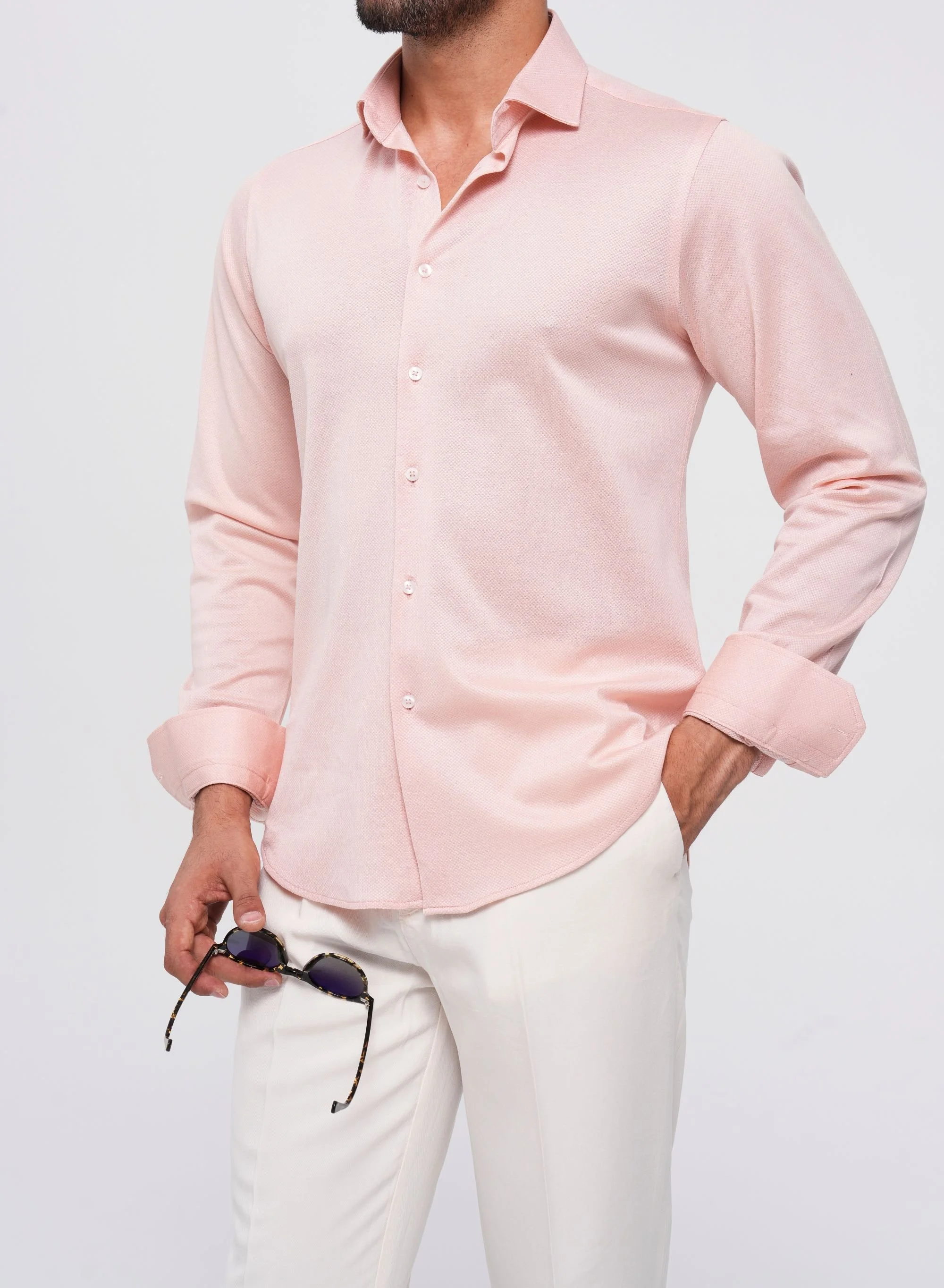
The Future of Shirts Does Not Have to Be Woven or Knitted
For brands, the more useful question is not:
“Will knitted shirts replace woven shirts?”
They do not need to.
A classic poplin shirt can remain the right product for formal business dressing.
Oxford can remain a menswear essential.
Linen can remain fundamental to summer collections.
And knitted shirts can create another possibility:
a product that preserves the identity of a shirt while changing how that shirt feels on the body.
That is the opportunity we see in the category.
For M.DAG, knitted shirt manufacturing is therefore not a departure from traditional shirtmaking.
It is an extension of it.
The same principles still matter:
Understand the fabric.
Develop the correct pattern.
Build the right collar.
Control the construction.
Test the product.
Preserve the fit.
And make sure bulk production behaves like the shirt the brand originally approved.
For USA brands searching for a knitted shirt manufacturer, jersey shirt manufacturer, private label men's shirt manufacturer or specialized shirt factory, this is the distinction worth looking for:
Do not simply find a factory that can sew knitted fabric.
Find a manufacturer that understands how to turn knitted fabric into a shirt.
