
Why the Same Collar Looks Different on Every Fabric
A fashion brand develops a shirt with the perfect collar.
The height is right. The points have the desired length. The spread looks balanced. The collar roll creates exactly the character the designer wanted.
The sample is approved.
A few months later, the brand decides to use exactly the same shirt design in a different fabric.
The same pattern is used. The same collar dimensions are specified. The same construction is requested.
But when the new sample arrives, the collar looks different.
Why?
Because in shirt manufacturing, a collar is not defined by its pattern alone.
Fabric weight, weave, density, stiffness, elasticity, finishing, interlining, fusing and even pressing can change how exactly the same collar behaves.
This is one of the reasons specialized shirt manufacturing requires more than simply following a technical specification.
At Mehmet Dağ Shirts, after more than 25 years focused on men's shirt manufacturing, we have learned an important principle:
You cannot separate collar design from fabric behavior.
A collar that works beautifully in one fabric may need technical adjustment when the fabric changes.
For brands developing private label shirts, understanding this relationship can prevent disappointing samples, unnecessary revisions and inconsistent collections.
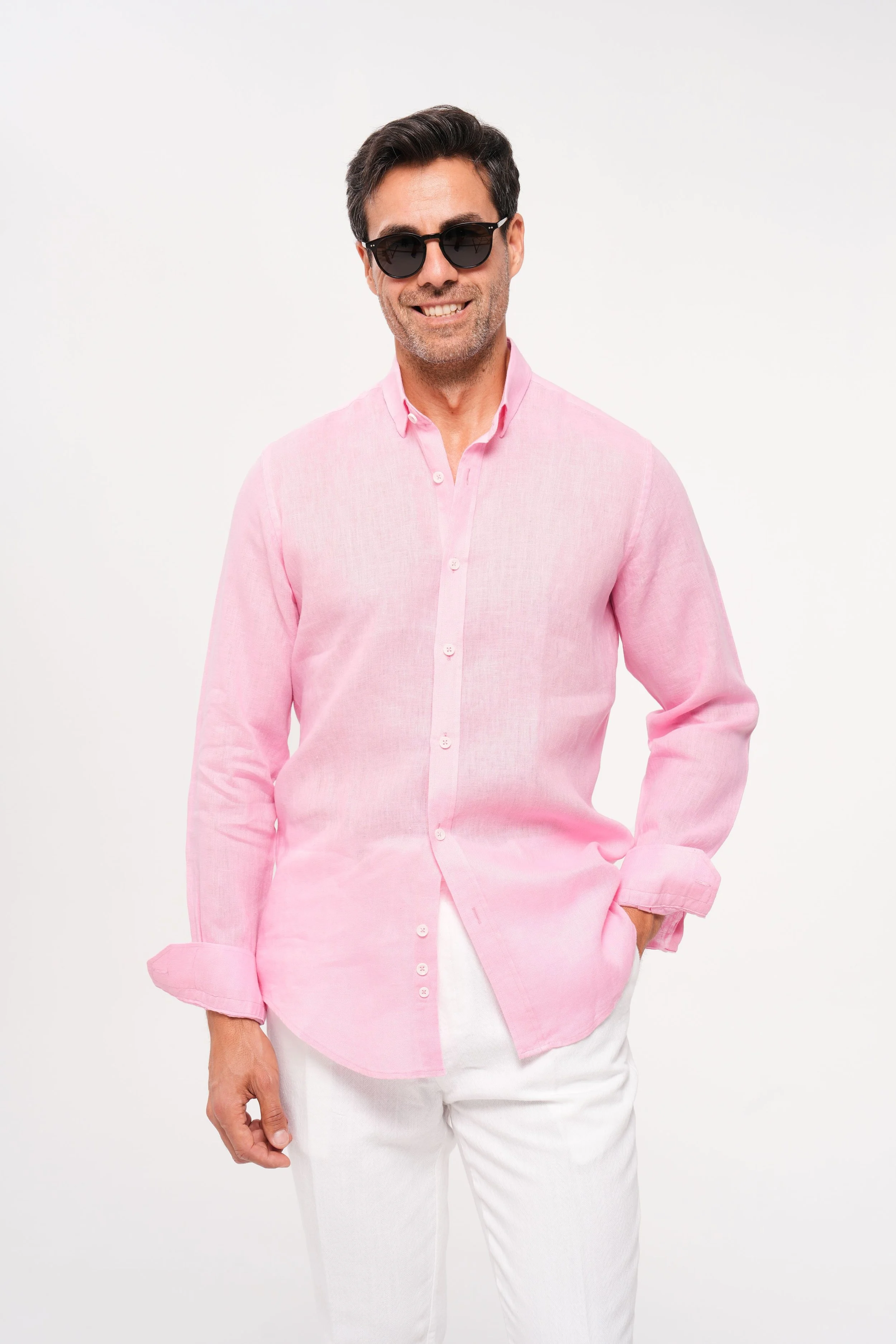
A Collar Is a Three-Dimensional Structure
On a technical drawing, a collar looks relatively simple.
There is a shape.
There are measurements.
There is a collar point.
There is a collar stand or another chosen construction.
But once manufactured, the collar becomes a three-dimensional structure that has to interact with the neck, shoulders and front opening of the shirt.
It needs to bend.
It needs to roll.
It needs to retain enough structure.
It needs to respond naturally when the top button is opened.
And depending on the design, it may also need to sit correctly underneath a jacket.
The pattern establishes the geometry.
But the fabric determines how much that geometry can actually express itself.
This distinction is fundamental.
The Same Pattern Does Not Guarantee the Same Collar
Imagine producing exactly the same collar pattern in five different fabrics:
Fine cotton poplin
Oxford
Twill
Linen
Stretch cotton
Technically, the dimensions of the pattern could remain identical.
Visually, however, the five collars may not look identical at all.
One may appear sharper.
Another may have more volume.
One may roll naturally.
Another may appear flatter.
A lightweight fabric might struggle to maintain the intended architecture.
A heavier fabric might make the same collar appear larger or more rigid.
This is why an experienced shirt manufacturer should not automatically assume that an approved collar construction can be transferred unchanged to every new fabric.
Fabric Weight Matters—but It Is Only the Beginning
Fabric weight influences collar behavior, but weight alone does not tell the whole story.
A heavier fabric generally has more body than an extremely lightweight fabric.
However, two fabrics with similar weights can still behave very differently.
Why?
Because weight is only one variable.
The manufacturer also needs to consider:
Weave structure
Yarn characteristics
Fabric density
Finishing
Surface treatment
Stretch
Recovery
Drape
Compressibility
Dimensional stability
This explains why evaluating a shirt fabric only by GSM can be misleading.
Two fabrics may have nearly identical weights but create completely different collar results.
Poplin Can Make a Collar Look Cleaner and Sharper
Poplin is widely used in men's shirts because of its smooth surface and relatively clean structure.
Depending on its construction and finishing, a fine poplin can create an elegant and precise collar appearance.
But lightweight poplin also creates challenges.
If the fabric has limited body, the collar may depend more heavily on the correct interlining and construction to maintain its intended shape.
Too little support and the collar can appear weak.
Too much support and the collar may feel disproportionately rigid compared with the body of the shirt.
The challenge is therefore not simply to make the collar stiff.
It is to create the right relationship between the collar and the shirt fabric.
Oxford Fabric Creates a Different Collar Character
Oxford fabric generally has more visible texture and body than fine poplin.
As a result, exactly the same collar geometry may appear fuller or more substantial when produced in Oxford.
That can be desirable.
For a casual button-down shirt, the fabric's natural body may contribute to the character of the collar.
But transferring a collar developed for lightweight poplin directly into a heavier Oxford without considering the difference can change:
Collar thickness
Edge appearance
Roll
Point behavior
Neckline feel
Overall visual proportion
The collar has not necessarily been manufactured incorrectly.
The material has changed the way the construction behaves.
Linen Introduces Another Set of Variables
Linen is particularly interesting because its natural character is part of its appeal.
A linen shirt is not normally expected to behave like a crisp formal poplin shirt.
Its texture, movement and natural irregularity contribute to its relaxed appearance.
This means collar development should respect the character of the material.
Attempting to force a lightweight linen into an extremely rigid collar construction can create a disconnect between the body and collar.
At the same time, insufficient stabilization may allow the collar to lose too much of the intended shape.
The correct solution depends on what the brand wants the shirt to become.
A relaxed summer linen shirt?
A more structured linen business shirt?
A resort shirt worn predominantly open?
The answer affects the collar strategy.
Stretch Fabric Changes the Equation Again
Stretch introduces movement that traditional woven fabrics may not have to the same degree.
When elastane or mechanical stretch is present, the relationship between the outer fabric and the materials used to stabilize the collar becomes particularly important.
The body fabric may want to move.
The interlining may behave differently.
The sewing process may introduce tension.
The finished collar may respond differently during wear.
This is another reason why experienced private label shirt manufacturing cannot rely on a single construction formula for every fabric.
The fabric and the construction must be compatible.
Interlining Can Completely Change the Same Collar
Fabric is only half of the equation.
The interlining used inside the collar can dramatically influence the finished result.
Different interlinings can provide different levels of:
Firmness
Flexibility
Thickness
Recovery
Shape retention
This means exactly the same outer fabric and exactly the same collar pattern can produce noticeably different results simply by changing the interlining.
For brands, this is important because interlining should not be treated as an invisible commodity.
It is part of the collar design.
Harder Interlining Does Not Automatically Mean Better Quality
One of the easiest mistakes in collar construction is assuming that a firmer collar is always a better collar.
It is not.
The objective should not be maximum stiffness.
The objective should be the appropriate structure for the intended shirt.
A formal business shirt may require a clean, controlled collar.
A casual shirt may benefit from more natural movement.
A one-piece collar may require a particular balance between structure and roll.
A soft button-down collar needs another behavior.
If every collar is stabilized as firmly as possible, different designs begin to lose their intended character.
Premium shirt manufacturing is therefore not about maximizing every technical parameter.
It is about balancing them.
Collar Roll Changes With Fabric
Collar roll is one of the clearest examples of fabric and construction interacting.
The roll describes how the collar transitions from its attachment point and curves into its visible position.
A collar with a beautiful natural roll in one fabric may behave differently when produced in another.
A softer fabric may collapse more easily.
A heavier fabric may resist the intended curve.
A different interlining may create too much rigidity.
Fusing can further change the behavior.
For this reason, brands developing collars with a distinctive roll should evaluate the actual fabric + interlining + pattern + construction combination, not just the paper pattern.
Collar Points Can Behave Differently Too
The collar point is another area where fabric differences become visible.
A long collar point requires sufficient control to maintain the intended line.
With an unsuitable fabric/interlining combination, the point may:
curl,
lift,
collapse,
appear too thick,
or lose visual symmetry.
Shorter collar designs can react differently.
Again, the geometry has not necessarily changed.
The material's ability to hold that geometry has.
Fabric Thickness Changes the Finished Dimensions
This point is easy to underestimate.
Patterns are two-dimensional.
Fabric has thickness.
When multiple layers are folded, turned and pressed, fabric thickness influences the finished structure.
This becomes especially relevant around:
Collar edges
Collar points
Collar stand
Seam allowances
Folded areas
A construction developed using very fine fabric may become bulky when transferred directly to a significantly thicker material.
This can affect not only appearance but also the precision with which the collar can be turned and finished.
Fusing Is Part of Collar Engineering
When fusible interlining is used, the fusing process itself becomes another variable.
Temperature, pressure and time need to work with the specific materials being used.
The objective is to create stable bonding without damaging the fabric or creating unwanted changes in hand feel and appearance.
Poor compatibility or poorly controlled fusing can contribute to problems such as:
Bubbling
Delamination
Excessive stiffness
Distortion
Uneven appearance
This is why a collar cannot be understood simply as "fabric plus pattern."
Manufacturing process matters too.
Pressing Can Make Two Identical Collars Look Different
Pressing is often considered a finishing operation.
In shirt manufacturing, it can influence the way a collar presents itself.
The amount of steam, heat, pressure and shaping applied during finishing can affect the final appearance.
A collar designed to have a natural roll can be flattened by inappropriate pressing.
A structured collar may look unfinished if it is not shaped correctly.
This means the final appearance of a collar is created through several stages:
Pattern → Fabric → Interlining → Sewing → Fusing → Turning → Pressing
The finished collar is the result of the entire chain.
The Neckline Also Influences How the Collar Looks
Not every apparent collar problem originates in the collar.
This is an important technical distinction.
The collar interacts with the neckline and the rest of the garment.
If the neckline geometry, shoulder balance or front opening changes, the collar may sit differently even if the collar pattern itself has not changed.
This is particularly noticeable when a shirt is worn open.
The relationship between the collar, neckline, placket and upper chest determines how the shirt frames the wearer's neck and face.
An experienced men's shirt manufacturer therefore evaluates the collar as part of the garment rather than as an isolated component.
Open-Neck Shirts Make Fabric Behavior Even More Visible
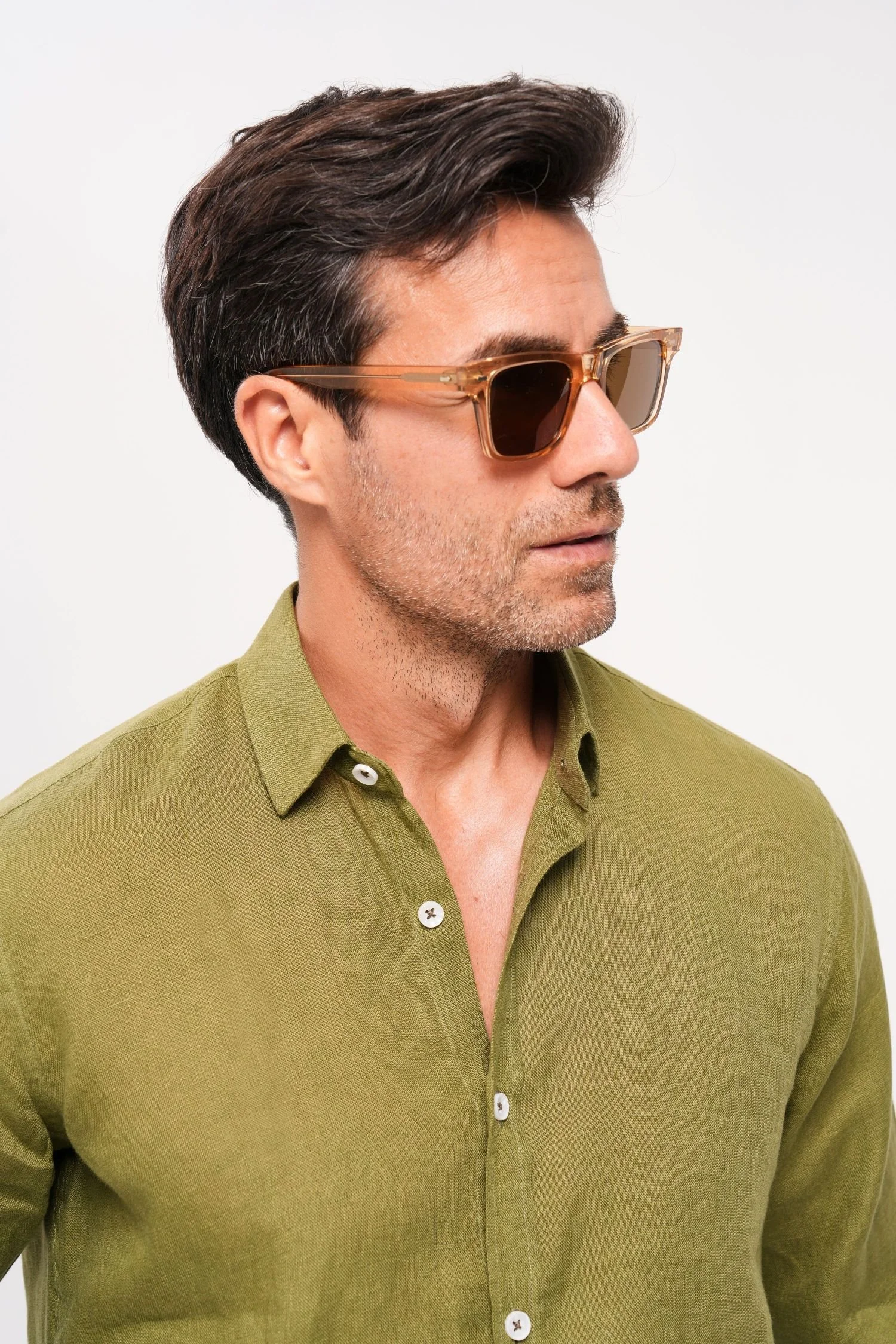
When a shirt is designed primarily to be worn with the top button open, collar behavior becomes particularly important.
Without the top button holding the neckline closed, the collar needs to find its shape naturally.
Some fabrics create an elegant opening.
Others may spread too far.
Some collars may fall backward.
Others may stand too rigidly.
This is especially important in:
Casual shirts
Linen shirts
Resort shirts
One-piece collar shirts
Contemporary business shirts worn without a tie
For these products, collar development should consider how the shirt looks when actually worn, not only when buttoned and laid flat.
One-Piece Collars Make Fabric Selection Even More Important
The relationship between fabric and collar becomes particularly visible in a one-piece collar shirt.
Because the construction creates a more integrated transition between the collar and the shirt body, fabric behavior strongly influences the roll and opening.
A one-piece collar that looks elegant in one cotton quality may require adjustment when reproduced in linen or another fabric.
This is why specialized constructions should be tested as complete systems rather than copied mechanically from one fabric to another.
Changing the Fabric Can Require Pattern Adjustments
This does not mean that every fabric change requires a completely new collar pattern.
Often it does not.
But manufacturers should be prepared to evaluate whether an adjustment is necessary.
Depending on the difference between fabrics, development might involve changing:
Interlining
Collar point
Collar height
Collar spread
Seam allowance
Construction method
Fusing parameters
Pressing method
Sometimes the pattern remains untouched and the solution is found elsewhere.
Sometimes a small pattern modification creates a significantly better result.
The important thing is not to assume.
Test the actual combination.
Why First Samples Matter When Changing Fabric
Suppose a brand has sold the same shirt for three seasons.
The fit is successful.
The collar is recognizable.
Customers like the product.
Now the brand wants a summer version in a lighter fabric.
It may be tempting to skip development because the style already exists.
But the fabric is part of the product.
A new sample allows the manufacturer and brand to confirm whether the established collar still produces the intended result.
If it does, excellent.
If not, the adjustment can happen before hundreds or thousands of shirts are produced.
This is exactly why professional sampling is not wasted time.
It reduces uncertainty before bulk production.
A Brand's Signature Collar Requires More Than a Pattern File
Many shirt brands want to develop a recognizable collar.
This is a strong strategy.
A distinctive collar can become part of a brand's visual identity.
But once a signature collar is established, maintaining its identity across multiple fabrics becomes a manufacturing challenge.
If the brand uses:
poplin in its business collection,
Oxford in its casual collection,
linen in summer,
and stretch fabrics in another line,
the goal is not necessarily to make every collar physically identical.
The goal is to preserve the same design identity while adapting the construction to the material.
That requires judgment.
Consistency Does Not Always Mean Identical Construction
This principle is extremely important in private label manufacturing.
Brands often associate consistency with using exactly the same technical solution every time.
But true product consistency can sometimes require changing the technical solution.
For example:
Fabric A may require Interlining X.
Fabric B may require Interlining Y.
The construction may be adjusted slightly.
The pressing approach may differ.
Yet the consumer sees two collars that clearly belong to the same brand.
That is successful manufacturing.
Consistency of result does not always require identical methods.
This Is Where Shirt Specialization Matters
A general garment factory may be perfectly capable of sewing a shirt.
But collars are one of the areas where long-term specialization in shirts creates practical knowledge.
Over time, a specialized shirt manufacturer encounters:
different fabrics,
different collar geometries,
different interlinings,
different fits,
different washing requirements,
different customer expectations.
That experience creates a library of cause and effect.
What happens if this fabric is combined with that structure?
Why did this collar behave differently after washing?
Why does this material need more support?
Why does the same pattern suddenly appear larger?
This manufacturing memory is difficult to replace with machinery alone.
What Should Brands Ask Their Shirt Manufacturer When Changing Fabric?
Instead of simply asking:
"Can you make the same shirt in this fabric?"
brands can ask more useful questions:
Will this fabric change the collar appearance?
Can we use the same interlining?
Does the collar need more or less support?
Will the collar roll change?
Is the fabric suitable for this collar geometry?
Should we make a new sample before bulk production?
How will the collar behave after washing?
Will the fabric thickness affect the collar points?
Does the fusing process need to change?
Can we maintain the same brand identity across different fabrics?
These questions reveal whether the manufacturer is thinking about the complete product.
How Mehmet Dağ Shirts Approaches Collar and Fabric Compatibility
At Mehmet Dağ Shirts, we have focused on men's shirt manufacturing for more than 25 years.
Working with different brands, fabrics, fits and collar constructions has taught us not to treat collar development as an isolated operation.
When a project requires it, we evaluate the relationship between:
Fabric construction
Fabric weight and body
Collar pattern
Interlining
Desired stiffness
Collar roll
Neckline
Fit
Fusing
Sewing
Pressing
Intended use of the shirt
Our objective is not simply to reproduce the same technical recipe across every fabric.
It is to preserve the design intention of the brand while adapting the manufacturing approach when the material requires it.
Private Label Shirt Manufacturing Requires Adaptability
Private label production makes this particularly important because every brand has a different definition of the ideal shirt.
One customer may want a sharp business collar.
Another may want an extremely soft casual collar.
Another may want a strong one-piece collar with a distinctive roll.
Another may want a linen shirt that feels naturally relaxed.
The role of a private label shirt manufacturer is not to force all of those products into the same manufacturing standard.
It is to understand the desired result and build an appropriate production solution around it.
This is one of the fundamental differences between manufacturing shirts and simply sewing them.
Why Turkey Remains an Important Location for Shirt Manufacturing
For European and international brands, Turkey offers an interesting combination of textile knowledge, fabric access, manufacturing infrastructure and geographical proximity to major European markets.
But location alone does not determine manufacturing quality.
Brands looking for a shirt manufacturer in Turkey should still evaluate specialization, development capability, communication, flexibility and production consistency.
A factory's address tells you where your shirts are produced.
Its technical decisions tell you how well they will be produced.
Mehmet Dağ Shirts: Specialized Men's Shirt Manufacturing in Istanbul
Mehmet Dağ Shirts is a family-owned men's shirt manufacturer in Istanbul, Turkey, with more than 25 years of industry experience.
Our focus is shirts.
We work with private label brands across different markets and support projects involving different fabrics, fits, collar constructions, custom accessories and product requirements.
Our production capabilities include business, casual and more specialized shirt constructions, with flexible production possibilities for brands that need both product-development support and scalable manufacturing.
That specialization matters when small details—such as the interaction between a collar and a new fabric—determine whether the finished product feels ordinary or intentional.
What Makes a Reliable Shirt Manufacturer?
Reliability in shirt manufacturing is not simply delivering the correct quantity on the agreed date.
Those things matter.
But technical reliability goes deeper.
A reliable manufacturer should understand that changing one variable can affect another.
Change the fabric, and the collar may change.
Change the interlining, and the hand feel may change.
Change the fit, and the neckline may behave differently.
Change the washing process, and dimensional behavior may change.
Manufacturing expertise is therefore largely about understanding relationships between variables.
The better those relationships are understood before bulk production, the fewer surprises appear afterward.
Final Thoughts: The Collar Is Never Just the Collar
So why does the same collar look different on every fabric?
Because a collar is not an independent object.
It is the result of a system.
Pattern geometry + fabric behavior + interlining + construction + fusing + sewing + pressing + garment balance = the finished collar.
Change one part of that system and the result can change too.
For fashion brands, this leads to an important sourcing lesson:
Do not evaluate a shirt manufacturer only by whether it can follow your pattern.
Evaluate whether it understands what happens when the variables around that pattern change.
At Mehmet Dağ Shirts, more than 25 years of specialization in men's shirts has taught us that successful manufacturing is rarely about applying the same solution to every product.
It is about knowing which details must remain consistent—and which technical decisions must change in order to keep the final result consistent.
Because when a customer looks at your shirt, they do not see the pattern, interlining, fusing parameters or production decisions behind the collar.
They simply see whether the collar looks right.
